Riverlands Heritage Region Formed in Saskatchewan
Purpose: to preserve the historical contributions of Russian peopleswho settled on the Canadian prairies over a century ago
A
preliminary news bulletin by Koozma J. Tarasoff,
December 19, 2007
Updated December 29, 2007 by John Atamanenko
Updated December 30, 2007 by project Vice-President Maurice Postnikoff
Updated July 8, 2008
Updated September 10, 2020 by Andrei Conovaloff
Updated December 29, 2007 by John Atamanenko
Updated December 30, 2007 by project Vice-President Maurice Postnikoff
Updated July 8, 2008
Updated September 10, 2020 by Andrei Conovaloff
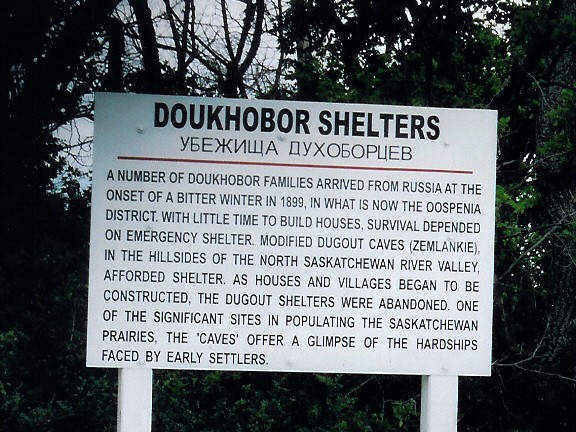 A new player has arrived in
Western Canada to preserve the heritage of Russian settlers
who settled in the West as farmers beginning in the late
1800s. It is called the Riverlands
Heritage Region and it came about as a result of
two decades of planning by several people doing historical
research, talking to local people, designing maps (below),
markers (in photos), and a brochure.
A new player has arrived in
Western Canada to preserve the heritage of Russian settlers
who settled in the West as farmers beginning in the late
1800s. It is called the Riverlands
Heritage Region and it came about as a result of
two decades of planning by several people doing historical
research, talking to local people, designing maps (below),
markers (in photos), and a brochure.This history tour project has been funded by Maurice Postnikoff of Saskatoon and Walter Kabaroff of Blaine Lake, and the Saskatoon Russian Cultural Club.
On December 18, 2007, John E. Atamanenko of Saskatoon, Saskatchewan, president of the Saskatoon Russian Cultural Club and Treasurer of the Riverlands Heritage Region project committee writes:
‘The initiative came from
several conversations with progressive people. It was
kicked off by Maurice Postnikoff of Saskatoon and Walter
Kabaroff of Blaine Lake (Walter is a member of the Rural
Municipality Council for Division 1, Blaine Lake R.M.
434). I joined them after some of the work was done and I
proposed creating a more formal body so that we could
continue to expand on identifying historical areas where
Russian people have settled. In collectively agreeing to
this, we are now moving ahead by completing Phase I in the
Blaine Lake area. Phase II will be in the Langham area. We
are making sure that the Doukhobor inputs and early
settlements are well identified and recognized.
‘ Now that we are formally organized, we have our officers: Alec Postnikoff, President; Walter Kabaroff, Secretary; John Atamanenko, Treasurer; Maurice Postnikoff, Publicity; Lawrence Osachoff, Jim Postnikoff and Nick Postnikoff as Directors.
‘As an arm of the Saskatoon Russian Cultural Club, Riverlands will jointly apply for funding to the Saskatchewan Lottery and Gambling Authority (SLGA) in Regina to conduct Bingo events and raise funds for our projected needs.
 ‘Enclosed is a preliminary map (#1) of our
Heritage sites in Phase I, which serves as a self-guided
Tour Map. [Download a high resolution image
of this map #1 to view or print.] Our last
step before Spring is to produce a 9” by 12” folded full
colour brochure.
‘Enclosed is a preliminary map (#1) of our
Heritage sites in Phase I, which serves as a self-guided
Tour Map. [Download a high resolution image
of this map #1 to view or print.] Our last
step before Spring is to produce a 9” by 12” folded full
colour brochure.
‘At our last meeting we have decided to expand our membership to include Bill Woiken and Mich Ozeroff and perhaps some younger members.
‘My feeling is that if our generation of people continues to be idle, the future generation would know nothing about their rich heritage. With the passing of our elders and the abandonment of our former villages, already much has been lost.
‘Should we live long enough, our long term plan is to expand into the Eastern part of the Province and engage people there who could contribute their expertise and labour towards Phases III and IV and maybe V.
‘So the wheels are rolling and the project continues….’
Of the 10 landmarks on the first map, 4 feature Doukhobor
place names which have been compiled by Jonathan Kalmakoff
in his Doukhobor Gazetteer:‘ Now that we are formally organized, we have our officers: Alec Postnikoff, President; Walter Kabaroff, Secretary; John Atamanenko, Treasurer; Maurice Postnikoff, Publicity; Lawrence Osachoff, Jim Postnikoff and Nick Postnikoff as Directors.
‘As an arm of the Saskatoon Russian Cultural Club, Riverlands will jointly apply for funding to the Saskatchewan Lottery and Gambling Authority (SLGA) in Regina to conduct Bingo events and raise funds for our projected needs.
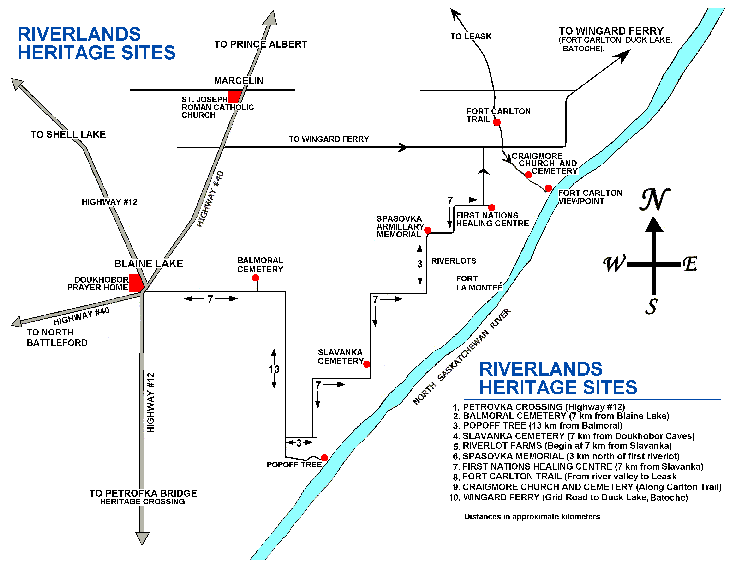 ‘Enclosed is a preliminary map (#1) of our
Heritage sites in Phase I, which serves as a self-guided
Tour Map. [Download a high resolution image
of this map #1 to view or print.] Our last
step before Spring is to produce a 9” by 12” folded full
colour brochure.
‘Enclosed is a preliminary map (#1) of our
Heritage sites in Phase I, which serves as a self-guided
Tour Map. [Download a high resolution image
of this map #1 to view or print.] Our last
step before Spring is to produce a 9” by 12” folded full
colour brochure.‘At our last meeting we have decided to expand our membership to include Bill Woiken and Mich Ozeroff and perhaps some younger members.
‘My feeling is that if our generation of people continues to be idle, the future generation would know nothing about their rich heritage. With the passing of our elders and the abandonment of our former villages, already much has been lost.
‘Should we live long enough, our long term plan is to expand into the Eastern part of the Province and engage people there who could contribute their expertise and labour towards Phases III and IV and maybe V.
‘So the wheels are rolling and the project continues….’
- 1. Petrofka Crossing (Bridge)
- 3. Popoff Tree
- 4. Slavanka Cemetery
- 6. Riverhill (Spasovka) Armillary (sundail) Memorial (in cemetery)
 |
 |
| Saskatchewan’s Largest Tree Saskatchewan’s largest tree is often associated with Samuel J. Popoff who leased the crown land on which the tree is located. A plains cottonwood cross, with black or balsam poplar, the Popoff tree stands nearly 21 meters (68 feet) high at the present time, as the top was sheared off by lightning. The tree has a girth of about 5 meters (over 16 feet) and a span reaching 32 meters (over 104 feet). Estimates place the age of the tree at over 160 years. The tree is one of the few remaining giant cottonwoods as most have fallen to the saw and the axe. | Armillary monument at Riverhill (Spasovka) Cemetery, built by Maurice Postnikoff. (Photographer and copyright holder: Jonathan Kalmakoff) |
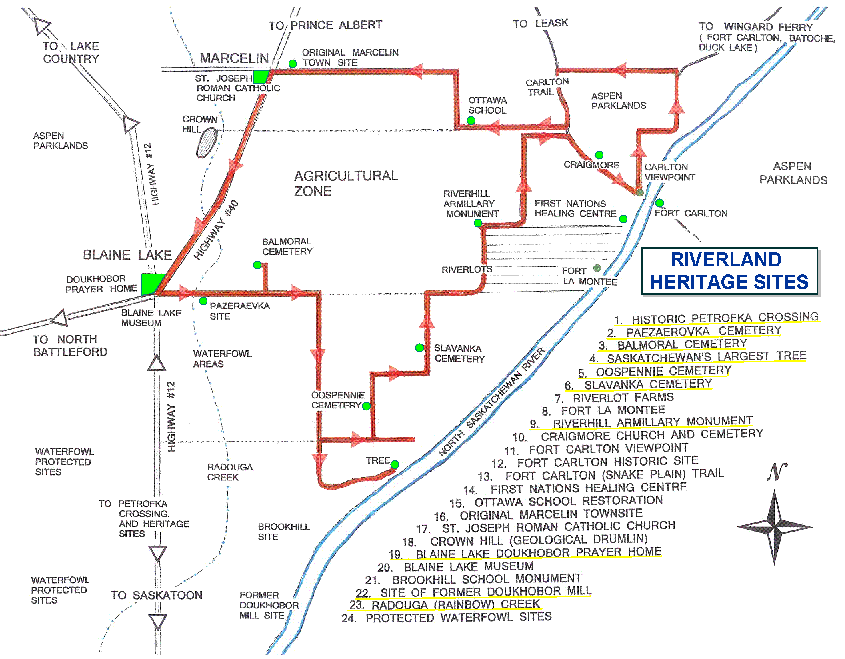 December
29, 2007, John Atamanenko sent a revised Phase
I preliminary map #2 (right) showing a tour route in
red for 25 historic sites, 10 feature Doukhobor place names
underlined in yellow.
December
29, 2007, John Atamanenko sent a revised Phase
I preliminary map #2 (right) showing a tour route in
red for 25 historic sites, 10 feature Doukhobor place names
underlined in yellow.
- 1. Historic Petrofka Crossing
- 2. Paezaerovka Cemetery
- 3.
Balmoral Cemetery
- 4. Saskatchewan's Largest Tree
- 5. Oospennie Cemetery
- 6. Slavanka Cemetery
- 9. Riverhill Armillary Monument
- 19. Blaine Lake Doukhobor Prayer Home
- 22. Site of Former Doukhobor (Flour) Mill along
Radouga Creek
- 23. Radouga (Rainbow) Creek
Thanks to research of Doukhobor Place Names posted by Jonathan Kalmakoff on his Doukhobor Genealogy Website, most of the Doukhobor sites have alaready been documented individually. Phase I covers a small area in the upper right corner of the 1905 Saskatchewan Doukhobor Colony. The committee is trying to make it easier for visitors to find them collectively. Jon says he has driven the route and is working with the committee. Soon Jon will post his maps with links to work he has already done and is updating.
More maps, photos, and progress news to be posted when available....
 |
 |
| First Nations Visitor Centre Overlooking the beautiful valley of the North Saskatchewan River, the Centre focuses on healing, meditation and wellness. From this location, one can view Fort Carlton downriver and upriver, the former site of Fort la Montee. Adjacent to this Parklands site, a ravine with flowing water and a buffalo pound illustrate the appearance of the countryside before the advent of agriculture. |
Riverlot
Farms Saskatchewan is surveyed on a grid system with individual Quarter Sections measuring ½ by ½ miles. The riverlots at Riverhill and at other locations, notably at Batoche, employ a different system. At Riverhill (Spasovka) District, individual riverlots are 1/8 by 2 miles in size. The area of a single riverlot is equal to the area of a Quarter Section. Two locations of note are found within these 16 riverlots: Riverhill (Spasovka) Cemetery, and the original site of Fort la Montee, a North West Company Trading Post which amalgamated with Fort Carlton of the Hudson’s Bay Company in 1821. |
E-mail Sent: Sunday, December 30, 2007
From: Maurice Postnikoff
Re: Riverlands Heritage Region
Thank you for showing an interest in the Riverlands Heritage Region. John Atamanenko contacted me just before Christmas to say that he was in touch with you regarding our organization and our plans for the future. He made available your response and we thank you for posting the information on your website.
Riverlands has been a topic of discussion and planning for over a decade between Walter Kabaroff and myself, beginning before 1990. As John Atamanenko offered assistance from the Russian Cultural Club a few years ago, he may not be completely aware of our past research and work. I have informed John that this e-mail to you, albeit lengthy, may clarify these matters.
As a young boy growing up in the early 1940's I recalled a number of elderly Doukhobors referring to the area between Petrofka and Wingard Ferry to the north, as the Riverlands. This general area encompasses 5-6 school districts and is a strip of land measuring approximately 40 x 10 kilometers. Many settlers and farmers in the area were of a Doukhobor extraction, but included in the mix were Germans, Dutch, Austrians, Ukrainians, English and people of other backgrounds. The genesis of our endeavour thus began in the interest shown, as elders spoke about the land. In choosing a name for the region, Walter and I thought it would be appropriate to honour and refer to the past, hence the name Riverlands.
In wishing to provide a lasting memorial to the pioneers of the region, I designed and had built a large armillary monument (sundial) placed at Riverhill Cemetery [above]. The funding was provided by donations from local families and those with family members buried in the cemetery. The armillary was unveiled in 2003. Walter Kabaroff was project manager for site preparation and mounting. Later both of us raised funds to create a brick and chain fence around the cemetery to prevent it being lost as has happened to many small country cemeteries. A local farmer — Jim Postnikoff — generously donated funds for the fabrication of wrought iron gates. Visitors from many provinces and countries have commented on the attractiveness of this site. It remains a place of pride not only for those with family buried there, but from the entire region.
Through the 1980's to the present, Walter Kabaroff and I have traveled the countryside, locating sites, drawing maps, photographing areas, interviewing people and compiling information for a heritage tour. We identified 15 sites of consequence in the Riverlands area that warranted special attention. Many of the sites, but not all, had a Doukhobor connection. We realized that the sites of consequence for the first phase of the project should include both cultural, historical, and physical areas, and not exclude any peoples or areas of interest within the Riverlands region.
The following sites have been identified as phase one of the Riverlands Heritage Tour which is self-guided through maps and road signs.
Recently a meeting was held to formalize our committee / organization. I proposed the following as members of the executive and was pleased that all in attendance accepted.
To clarify several items that have been mentioned in John's [Atamanenko] and your correspondence: the Riverlands Heritage Region is not a project of the Russian Cultural Club and is not associated with the club. The club offered funding for the information signs and the offer was accepted, with only the proviso mentioned earlier.
We are also excluding the FIRST NATIONS HEALING CENTRE from the tour at this time, at the request of the director, Fred Campeau. Visitors in the past have disrupted the meditation and healing programs. Once the plans for a visitor and research centre are complete, we are told that the Centre will welcome visitors once again.
The Riverlands Heritage Region committee is developing plans to expand research, various developments and the tour. The future is certainly exciting and we all look forward to developing a better understanding of our multicultural society and developing and preserving sites of significance.
Thank you for your interest and attention. We welcome your inquiries, suggestions and advice on Riverlands endeavours.
More maps, photos, and progress news to be posted when available....
Update (September 2022):
John E. Atamanenko, 91, died August 8, 2022. He asks you to plant trees in his memory.
When we were compiling this web page in 2007, Brenda Cheveldayoff owner of the Doukhobor Dugout House, emphatically insisted that we do not show her business on the project map or list it, for fear of vandalism. In 2008 we removed her organization, though her website had a map. In 2013, she expanded her promotion to Facebook; and, now has completely about-faced, making sure that everyone can easily find her "Doukhobor Caves", by map, address, directions, and 4 road signs. It is shown on the new Riverlands Heritage Region (PDF) map and listed as an activity on the website.
In 2021, the project was incorporated as 'Riverlands Heritage Preservation Region, Inc.' — a 30 kilometre self-tour of 30 locations in about 4 hours. It gets some financial support from City Centre Bingo in Saskatoon (John Atamanenko's charity) and Sask Lotteries. Some locations are signed as a 'Riverlands Region Site'.
About 2017, Diana Fedosoff was hired to create a 14 minute narrated video: Riverlands Heritage Region Tour, posted on Vimeo (Doukhobors mentioned 4 times). and a website with a virtual tour.
The beginning video narration appears to infer that Doukhobors are their own nationality: '... first inhabited by indigenous people, the region was settled further by Europeans -- British, French, Doukhobor, Rumanian, German, Ukrainian, and others. ... '
The new map — 'Petrofka to Wingard' — published in 2015 mentions Doukhobors 13 times. On the website, The People section names Doukhobors 10 times, once as 'Russian Doukhobors'.. The map is vague on precise locations for the 29. Petrovka Area, which we detailed in Petrofka Ferry: Saskatchewan boyhood memories by Nick Troubetzkoy (Spirit-Wrestlers Blog, 6 October 2020).
#2. Pazeraevka Cemetery has a sign showing that 'Riverlands Heritage Area' is translated into Russian as: Историческая береговая зона риверлендз (literally: Historical riverbank zone riverland). There is no Russian term for 'riverlands' so it is written in Russian as it sounds in Canadian-English: riverlendz.
Much more about the Doukhobor locations can be found by searching Jonathan Kalmakoff's extensive website Doukhobor Heritage and Facebook page.
From: Maurice Postnikoff
Re: Riverlands Heritage Region
Thank you for showing an interest in the Riverlands Heritage Region. John Atamanenko contacted me just before Christmas to say that he was in touch with you regarding our organization and our plans for the future. He made available your response and we thank you for posting the information on your website.
Riverlands has been a topic of discussion and planning for over a decade between Walter Kabaroff and myself, beginning before 1990. As John Atamanenko offered assistance from the Russian Cultural Club a few years ago, he may not be completely aware of our past research and work. I have informed John that this e-mail to you, albeit lengthy, may clarify these matters.
As a young boy growing up in the early 1940's I recalled a number of elderly Doukhobors referring to the area between Petrofka and Wingard Ferry to the north, as the Riverlands. This general area encompasses 5-6 school districts and is a strip of land measuring approximately 40 x 10 kilometers. Many settlers and farmers in the area were of a Doukhobor extraction, but included in the mix were Germans, Dutch, Austrians, Ukrainians, English and people of other backgrounds. The genesis of our endeavour thus began in the interest shown, as elders spoke about the land. In choosing a name for the region, Walter and I thought it would be appropriate to honour and refer to the past, hence the name Riverlands.
In wishing to provide a lasting memorial to the pioneers of the region, I designed and had built a large armillary monument (sundial) placed at Riverhill Cemetery [above]. The funding was provided by donations from local families and those with family members buried in the cemetery. The armillary was unveiled in 2003. Walter Kabaroff was project manager for site preparation and mounting. Later both of us raised funds to create a brick and chain fence around the cemetery to prevent it being lost as has happened to many small country cemeteries. A local farmer — Jim Postnikoff — generously donated funds for the fabrication of wrought iron gates. Visitors from many provinces and countries have commented on the attractiveness of this site. It remains a place of pride not only for those with family buried there, but from the entire region.
Through the 1980's to the present, Walter Kabaroff and I have traveled the countryside, locating sites, drawing maps, photographing areas, interviewing people and compiling information for a heritage tour. We identified 15 sites of consequence in the Riverlands area that warranted special attention. Many of the sites, but not all, had a Doukhobor connection. We realized that the sites of consequence for the first phase of the project should include both cultural, historical, and physical areas, and not exclude any peoples or areas of interest within the Riverlands region.
The following sites have been identified as phase one of the Riverlands Heritage Tour which is self-guided through maps and road signs.
- PAZERAEVKA SITE — site east of Blaine Lake where Doukhobors celebrated St. Peter's Day
- BALMORAL CEMETERY — grave of William Diehl, a scout from the Canadian Militia to whom Louis Riel surrendered in 1885
- SASKATCHEWAN'S LARGEST TREE — located in the North Saskatchewan River valley at the former site of Laird Ferry
- OSPENNIA CEMETERY — potential site for the heritage tour, pending approval
- SLAVANKA CEMETERY — cemetery house is decorated in the style of Doukhobor art, from southern Russia (late 1800's)
- RIVERLOT FARMS — strips of land in the Riverhill District based on the Quebec land system, first settled by Métis people
- FORT LA MONTEE — site located on Riverlot farms along the river, disbanded in 1821 during amalgamation of the HBC and North West Companies
- RIVERHILL ARMILLARY — a giant sundial monument at Riverhill Cemetery (Spasovka) honouring the people who developed the land
- CRAIGMORE CHURCH — an idyllic small country church along the historic Fort Carlton Trail
- FORT CARLTON VIEWPOINT — overlooking the river valley, offering a breathtaking view of the river, the valley and the fort
- FORT CARLTON TRAIL — dating to prehistory, the trail (still in use) connected Fort Garry with Fort Edmonton
- OTTAWA SCHOOL — an incomplete restoration of a brick country school with orchard and a museum
- CROWN HILL — a geological drumlin (hill-like structure) located between Marcelin and Blaine Lake
- OTHER SITES PENDING APPROVAL — St. Joseph's Church, Doukhobor Prayer Home, flour mill site, museums, Doukhobor village sites, etc.
Recently a meeting was held to formalize our committee / organization. I proposed the following as members of the executive and was pleased that all in attendance accepted.
PRESIDENT — Alec
Postnikoff of Saskatoon
VICE-PRESIDENT — Maurice Postnikoff of Saskatoon
SECRETARY — Walter Kabaroff of Blaine Lake
TREASURER — John Atamanenko of Saskatoon
Other members of the organization include directors etc.
VICE-PRESIDENT — Maurice Postnikoff of Saskatoon
SECRETARY — Walter Kabaroff of Blaine Lake
TREASURER — John Atamanenko of Saskatoon
Other members of the organization include directors etc.
To clarify several items that have been mentioned in John's [Atamanenko] and your correspondence: the Riverlands Heritage Region is not a project of the Russian Cultural Club and is not associated with the club. The club offered funding for the information signs and the offer was accepted, with only the proviso mentioned earlier.
We are also excluding the FIRST NATIONS HEALING CENTRE from the tour at this time, at the request of the director, Fred Campeau. Visitors in the past have disrupted the meditation and healing programs. Once the plans for a visitor and research centre are complete, we are told that the Centre will welcome visitors once again.
The Riverlands Heritage Region committee is developing plans to expand research, various developments and the tour. The future is certainly exciting and we all look forward to developing a better understanding of our multicultural society and developing and preserving sites of significance.
Thank you for your interest and attention. We welcome your inquiries, suggestions and advice on Riverlands endeavours.
More maps, photos, and progress news to be posted when available....
Update (September 2022):
John E. Atamanenko, 91, died August 8, 2022. He asks you to plant trees in his memory.
When we were compiling this web page in 2007, Brenda Cheveldayoff owner of the Doukhobor Dugout House, emphatically insisted that we do not show her business on the project map or list it, for fear of vandalism. In 2008 we removed her organization, though her website had a map. In 2013, she expanded her promotion to Facebook; and, now has completely about-faced, making sure that everyone can easily find her "Doukhobor Caves", by map, address, directions, and 4 road signs. It is shown on the new Riverlands Heritage Region (PDF) map and listed as an activity on the website.
In 2021, the project was incorporated as 'Riverlands Heritage Preservation Region, Inc.' — a 30 kilometre self-tour of 30 locations in about 4 hours. It gets some financial support from City Centre Bingo in Saskatoon (John Atamanenko's charity) and Sask Lotteries. Some locations are signed as a 'Riverlands Region Site'.
About 2017, Diana Fedosoff was hired to create a 14 minute narrated video: Riverlands Heritage Region Tour, posted on Vimeo (Doukhobors mentioned 4 times). and a website with a virtual tour.
The beginning video narration appears to infer that Doukhobors are their own nationality: '... first inhabited by indigenous people, the region was settled further by Europeans -- British, French, Doukhobor, Rumanian, German, Ukrainian, and others. ... '
The new map — 'Petrofka to Wingard' — published in 2015 mentions Doukhobors 13 times. On the website, The People section names Doukhobors 10 times, once as 'Russian Doukhobors'.. The map is vague on precise locations for the 29. Petrovka Area, which we detailed in Petrofka Ferry: Saskatchewan boyhood memories by Nick Troubetzkoy (Spirit-Wrestlers Blog, 6 October 2020).
#2. Pazeraevka Cemetery has a sign showing that 'Riverlands Heritage Area' is translated into Russian as: Историческая береговая зона риверлендз (literally: Historical riverbank zone riverland). There is no Russian term for 'riverlands' so it is written in Russian as it sounds in Canadian-English: riverlendz.
Much more about the Doukhobor locations can be found by searching Jonathan Kalmakoff's extensive website Doukhobor Heritage and Facebook page.
Back to NEWS