Doukhobor Artist Jan
Kabatoff
Prepares Exhibit on Glaciers
Prepared by Koozma J. Tarasoff, January 22, 2008In my book Spirit Wrestlers: Doukhobor Pioneers’ Strategies for Living, 2002, pp. 74-76, readers will recall that Jan is a gifted artist in Western Canada who organized several art shows during the Doukhobor Centennial celebrations in the 1990s involving herself and other Doukhobor artists. [See: "Vechnaia Pamyat" Art Exhibit, Grand Forks, B.C. (8 June 1999)]
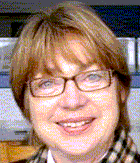
Her fascination with landscape and identity has won her most recent project in three continents and which may also include Antarctica later this year. Below, Jan describes her latest endeavour which combines art with climate change. We all wish her well in her unique multimedia journey. [Photo of Jan by Koozma J. Tarasoff.]
 Growing up in a rural community in British
Columbia and living for thirty years in the foothills of Alberta and in
the Rocky Mountains, has offered me a point of reference for my
nature-based work and a deep love and appreciation for the natural
environment.
Growing up in a rural community in British
Columbia and living for thirty years in the foothills of Alberta and in
the Rocky Mountains, has offered me a point of reference for my
nature-based work and a deep love and appreciation for the natural
environment.A recurring theme over the past twenty years has been close up studies of water, ice, geological formations and patterns in nature, as a way of connecting more symbiotically with the natural world. In recent years the issue of global warming and its effect on the rapid rate of glacial melt, and the impact this will have on ecosystems regionally and globally, have become a source of deep concern and investigation in my work.
 In the past two
years I’ve done extensive reading, research and trekking to glaciers in
British Columbia, the Yukon Territory, Alberta and Mongolia, for the
purpose of documentation and first-hand experience. From the Mongolian
scientists based at the Potanina Glacier in the Altai Mountains we
learned that the glacier is shrinking by four meters a year at lower
levels and two meters a year at the upper levels, which poses grave
concerns for a country with very little water and prone to drought
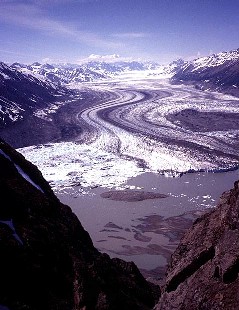
conditions. [Right: Lowell Glacier,Yukon Territory, Canada.]
In the past two
years I’ve done extensive reading, research and trekking to glaciers in
British Columbia, the Yukon Territory, Alberta and Mongolia, for the
purpose of documentation and first-hand experience. From the Mongolian
scientists based at the Potanina Glacier in the Altai Mountains we
learned that the glacier is shrinking by four meters a year at lower
levels and two meters a year at the upper levels, which poses grave
concerns for a country with very little water and prone to drought
conditions. [Right: Lowell Glacier,Yukon Territory, Canada.]My intention is to combine data gathered from various glaciers on different continents as a way of emphasizing the global environmental urgency and to present nature as a holistic and active force.
By merging scientific glacier data with first-hand impressions and various forms of documentation, I strive for a deeper understanding of the elemental forces that sustain life, and reflect on the gendered and dualistic world-views that tend to separate nature from culture and science from natural philosophy. Some of my strongest influences have been First Nations practices that relied on a notion of geography as being socially active and sentient, and principles that emphasize living in harmony with nature.
Exhibit schedule and reviews
2009 September 12 – November 11
Jan Kabatoff — GLACIER: A JOURNEY
Whyte Museum of the Canadian Rockies, Banff, Alberta
2009 December 18 – 2010 March 21
Ice Flows and Sound Retreats, Jan Kabatoff.
The Rooms Art Gallery, 9 Bonaventure Avenue, St. John's, Newfoundland