Hodge Podge
|
|||
| In the Doukhobor Inquirer (1954-1958),
two popular sections were "Hodge Podge" and "Briefly
Stated", very short stories about Doukhobors today, or
then. These short items are so impressive to read 50 years
later that I decided to continue this instant history in
the making which doesn't merit a full article but should
be passed along because it helps to shape our culture. Please contribute to Hodge
Podge if you have a short story which should be
preserved. The more the better. Back to Spirit-Wrestlers.com |
|||
|
|||
|
Put your Hodge Podge here ...
|
|||
|
2023 Apr 13 — No More DCSS or DOVE. Funds to Heritage Village and scholarships. Motion: That the (Independent) Doukhobor Cultural Society of Saskatchewan (DCSS) be DISSOLVED in its entirety and cease to exist, including the publication of the newsletter, the DOVE. That the existing directors shall disperse the funds of the Doukhobor Cultural Society of Saskatchewan in an orderly and timely measure as directed by the constitution of the DCSS with consideration given to individual subscribers of the DOVE who did not receive (all their) paid publications. MOVED: Sonia Tarasoff SECONDED: June Bold CARRIED The approximately $8000 current bank account will be directed to the Veregin NDHV. Saskatoon (DSS) will apply for some of the dollars to support scholarship funds. — Reported by Mae Popoff, April 7, 2023. And, Conovaloff archived the DCSS website |
  |
||
|
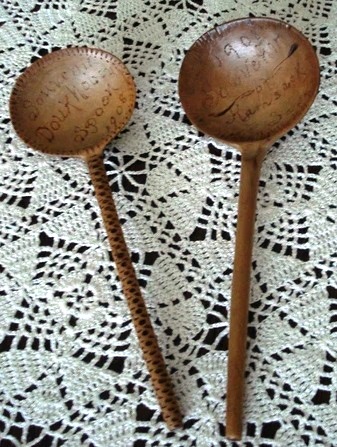
2023 Mar 3 — 1908 Doukhobor Spoons valued at $325+ each From: John D. Sewell. 'Antiques: Tiny treasure stands tall with value', March 9, 2023 Question: Years ago I acquired these handcrafted wooden Doukhobor spoons from a folk art dealer for $250. Ten years ago an appraiser told me they would be valued at $650. The spoons are a very light hardwood and measure 20 cm (8 inches). One spoon bowl is burned with “1908 Souvenir of Kamsack Sask,” and the other “Souvenir Doukhobour Spoon 1908.” I believe these spoons are from the first arrival and settling period of Doukhobors in Canada and were used as presentation gifts on special occasions. I would be very interested to learn about the possible makers and their value. Thank you. Gordon, Ottawa Answer: In keeping with your thoughts, Doukhobors first arrived in Canada in 1899. Their rich carving history included embellishment of any cherished objects. Briefly, religious beliefs conflicting with Orthodox Russian institutions, led to the diaspora of one localized group of people in the Ukrainian region of Kharkiv (Kharkov) beginning in the 1700s and the resulting ‘name’ of Doukhobors. This has given Canada an even more rich cultural heritage. Your dated spoons are unique and a rare form and I see no reason to differ with what you have learned of their value. The carver identity will require conversations and research with experts. Thank you for sharing. |
 |
||
|
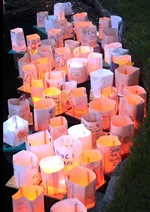
2022 Aug 6 — Hiroshima & Nagasaki Peace Memorial Lantern Ceremony, Ottawa About 100 people participated in the annual ceremony organized by the Society of Friends, with speakers, music, and floating candled lanterns. On this day, 77 years ago, the USA dropped an atomic bomb on the city of Hiroshima, Japan, killing 80,000 instantly. Horrific dying followed. Instead of writing this year, I recommend: 'Another Hiroshima is coming unless we stop it now', by John Pilger, 2020. See all my reports since 2009: 1945 A-bombing of Japan Memorials, Ottawa. I volunteered again to document the event, this year with 73 images, all open-source. Anyone can use and share them. |
 |
||
|
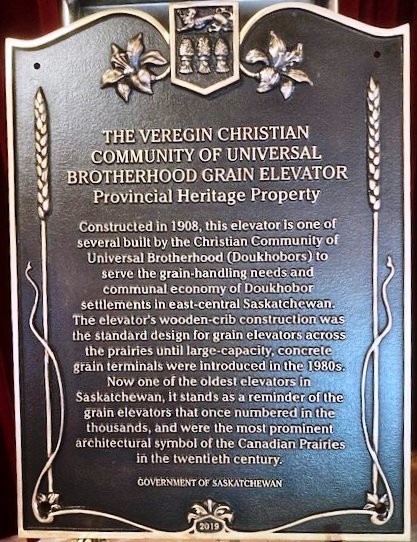
2022 Jul 17 — Veregin CCUB Grain Elevator gets Heritage Property plaque July 15-16, 2017 was the 100-year anniversary of the Historic Prayer Home in Veregin, SK. On August 28, 2018, the Doukhobor Grain Elevator in Veregin Saskatchewan was declared a Provincial Heritage Property (PDF). Today, nearly 4 years later, the building finally got its plaque (about 1' x 2'). Renovation fund-raising has been led by Andrew Kazakoff and Sid Reilkoff. Walter Ostoforoff, chairman, was MC. MLA Terry Dennis brought greetings from Premier Moe and Minister Ross. Reeve Harvey Malanowich of the RM of Sliding Hills complimented the work. Historian Jon Kalmakoff (Facebook) presented the elevator's history. Lunch was prepared by Tannis Negrave and Patti Negrave. See 8 photos and 3 summaries of the ceremony at Facebook: National Doukhobor Heritage Village Inc. In 2009 the National Doukhobor Heritage Village (NDHV) was honored: New Parks Canada Plaque Acknowledges National Significance of Doukhobors at Veregin, Saskatchewan, Doukhobor Heritage web site by Jonathan Kalmakoff. |
 |
||
|
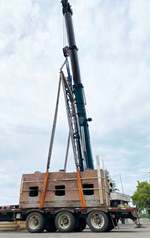
2022 Jul 4 — Saskatoon Doukhobor Bread Booth moved 70 meters After years of deliberation, the Doukhobor Bread Booth is finally moved across the midway onto a solid foundation with a new enclosure at Praireland Park, Saskatoon, SK. The park hired contractors to move this popular historical attraction, built in 1957, and erected a new booth around it, in compliance with food service health codes. A new 1 foot thick concrete foundation was built for the booth. For 3 days the old oven room walls and roof were removed in the rain while covered with a tarp and strapped for lifting. Today the heavy 3-firebox brick oven was hoisted onto a flatbed truck, driven 70 meters (230 feet) south, lifted and set on the new foundation. A 20+ year old crack along the right corner edge was repaired, and a new pre-fabricated booth was framed — just in time for 2022 Saskatoon EX fair starting August 9 for 6 days. The new booth is now located where the Main Midway meets the North Concession Row, with the pioneer exhibits — the Log Cabin Museum and new Kickin' Horse Saloon. Photos are being collected from 10+ sources into this Google Photo album: Doukhobor Bread move in Saskatoon July 4_2022. See the history: Doukhobor Bread-baking in Saskatoon. The Doukhobor Society of Saskatoon (Facebook) should issue a full report by next year. |
 |
||
|
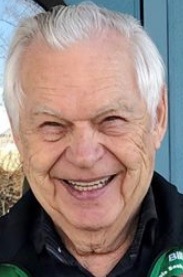
2019 Mar 21 — Saskatoon City Award to Bill Kalmakoff Bill Kalmakoff, Saskatoon, received a 'Living in Harmony Recognition Award' in a ceremony at the Broadway Theatre, presented by the City of Saskatoon Diversity, Equity and Inclusion Committee, for his efforts in 'elimination of racial discrimination ... to focus attention on the positive initiatives taking place in our community.' |
 |
||
|
2018 Oct 13 — Kamsack Local Heroes 'The Garden of Saskatchewan Citizen's Ring Award ... who have made an outstanding contribution to their community through public service in the community groups and local government. The award also was to provide a forum for discussing area development and improvement on an inter-community basis.'
|
 |
||
|
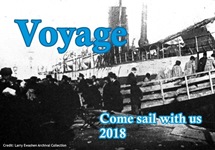
2018 May 21 — Doukhobor Dugout House : 2018 Theme Day — Opens July 7, 2018 Voyage : Come sail with us. We are planning a major quest. Pack your bag. Come home to history. Join the voyage at 11 am, 1 pm or 3 pm every Saturday in July. Please be on time, the ship cannot wait for those who are late for this exciting adventure. About the 18-day journey from the Russian departure aboard the Lake Huron on December 21, 1898, across the Atlantic to Halifax on January 23, 1899. Watch and taste hot Doukhobor bread baked in brick oven. Don’t miss the boat at Doukhobor Dugout Site, by Vivian Barwell, Battlefords News-Optimist, May 12, 2018. |
 |
||
|
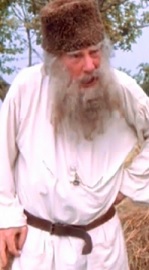
2017 July 10 — Leo Tolstoy as a Hero of Pop Culture in Russia Indiana Jones’ friend and a sinner: 10 unusual depictions of Leo Tolstoy, by Anastasia Tulyakova, Russia Behind the Headlines, July 4, 2017 — Satire about Lev Tolstoy's influence on Russian culture and society. The image of this elderly, bearded man, known for advancing moral principles, has become an archetype, a meme and a part of the cultural landscape. This English article is a short translation of 10 graphic depictions of Tolstoy, as the (1) sinner, (2) Christian, (3) god, (4) no pants, (5) conscience of the nation, (6) ideologue, (7) victim of slander, (8) mentor and friend of Indiana Jones (right), (9) meme, and (10) international star. The original Russian article has 31 items — 21 graphic, 6 literature, 2 poetry, and 2 Internet: Лев Толстой как герой поп-культуры (Leo Tolstoy as a hero of pop culture). Translation in-progress. |
 |
||
|
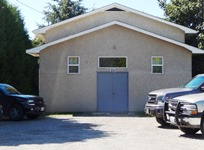
2016 July 27 — Creston dom to be Sold Larry Ewashen announced on his website — Larry's Desk — the decision of their Creston Doukhobor Society, 3411 Erikson Road, to liquidate assets : Creston Doukhobor Hall Sold. Also, the Doukhobor Exhibit, part of Born to the Soil, is at the Creston museum until the end of September 2016, maybe December 2016, depending on other exhibits planned. Ewashen reports on this exhibit which he and his brothers created: Doukhobor Pioneers of the Creston Valley. |
 |
||
|
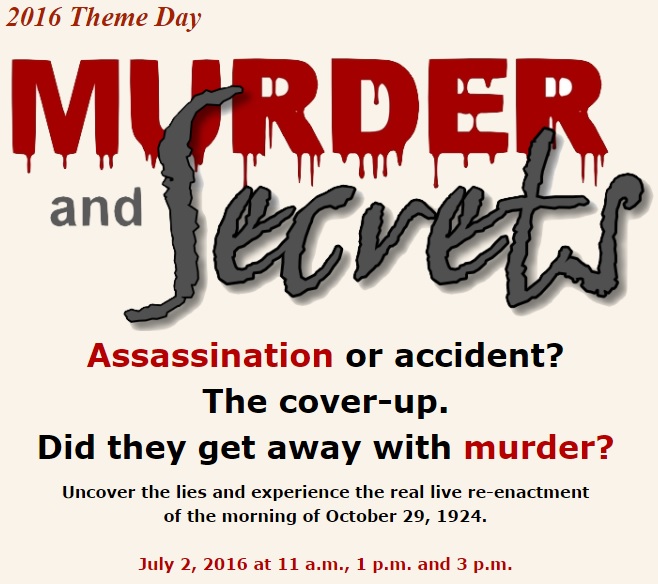
2016 June 17 — Murder and Secrets: theme for the 2016 Blaine Lake historic site, by Vivian Barwell, Shellbrook Chronicle, page 10. Announcement of opening of Doukhobor Dugout House July 2, 2016, about P.V. Verigin and his death in 1924, featuring historic actors and a recreation of the explosion. Narration by Brenda Cheveldayoff, who developed and inherited the historic site; and, Larry Ewashen, actor, filmmaker, former director of the Doukhobor Discovery Centre, and historian. Brenda lives on the original farm, near Blaine Lake, SK. Larry lives in Creston, BC, and posted a web page: Who Killed Peter Verigin? |
 |
||
|
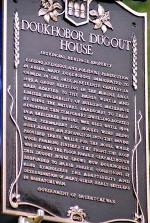
2015 June 5 — Doukhobor Dugout House Opens with Lecture on July 4, 2015 'There is a difference between Doukhobors and Sons of Freedom' is the 2015 opening theme at the Doukhobor Dugout House near Blaine Lake, Saskatchewan. The lecture-discussion occurs only on Saturday, July 4th in three sets: 11 am, 1 pm and 3 pm. Download a lecture handout, which Koozma prepared and shared with Brenda Chevaldayoff, owner and operator. This Provincial Heritage Property will also be open on July 11, 18, and 25. |
 |
||
|
2015 April 24 — Deadline for SK Doukhobor Scholarships: April 23, 2015 Students: Apply for the annual DSS scholarship for Saskatchewan Doukhobors. Awards are sponsored by the Doukhobor Society of Saskatoon (DSS) to commemorate 100 years in Canada. Two scholarships offered annually, value $750 each. Open to Saskatchewan Students of a Doukhobor background with self or family membership in a Saskatchewan Doukhobor Society. Selection is based on academic achievement and extracurricular activity. Download and mail application form. |
 |
||
|
2015 January 6 — Against Military Training in Regina schools On December 21, 2014, Mae Popoff sent a protest letter and circulated a petition. To: Premier Brad Wall, Saskatchewan.Copies were sent to 3 Doukhobor societies and 2 peace groups in Saskatchewan. More about these protests in Regina. |
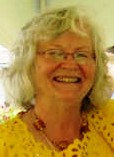 Mae Popoff, retired librarian and Doukhobor elder in Saskatoon. |
||
| 2013 April 10
— Koozma J. Tarasoff Speaking Tour at Schools in
Kootenays Ottawa Scholar Speaks News, Doukhobor Discovery Centre Doukhobor scholar, author, anthropologist and photo-grapher Koozma J Tarasoff was the featured speaker at the opening of the 39th season of the Doukhobor Discovery Centre in Castlegar, British Columbia on Sunday afternoon April 25, 2010. He outlined the world legacy of the great Russian writer and pacifist Count Lev N Tolstoy (1828 - 1910) on the life of the Doukhobors. The museum opening was dedicated to the 100-year anniversary of the death of this world figure. Tarasoff, who resides in Ottawa, Ontario spoke at high schools in Creston, Salmo, Nelson, Trail, Rossland, Castlegar, South Slocan, and Grand Forks between April 19th and May 5th, 2010. His mission was to share the beauty and wisdom of Tolstoy's quest for a just and moral life and the wisdom of the Doukhobor heritage. The program included a recent film about Doukhobors, a lecture about Tolstoy, questions, and a donation of his latest book, Spirit Wrestlers: Doukhobor Pioneers' Strategies for Living. Tolstoy is remembered not only for his masterpieces War and Peace and Anna Karenina, but also for his very modern and innovative philosophical and moral thoughts. He was in touch with world thinkers of the time and influenced Mahatma Gandhi and later Martin Luther King Jr. One of the key achievements of his life was saving the Doukhobors from annihilation and organizing and financially assisting the migration of 7,500 of them to Canada in 1899. |
 Koozma J. Taraksoff |
||
|
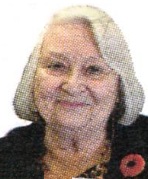
2011 March 29 — Booksigning by Joan Kazakoff Parker in Ontario, April 3, 16, 30
|
 |
||
|
2010 October 29 — Joan's Favourites, cookbook by Joan Kazakoff Parker Introduction: The following are a number of recipes [350 recipes, 186 pages], from various sources, all of which have been tried over the years. Many are related to my Russian Doukhobor heritage. I consider these to be among my most favourites. My grandparents, who were Doukhobors, emigrated to Canada from Russia in 1899. They became wheat farmers and settled on farms around Kamsack, Saskatchewan. Because of their religious beliefs, they were vegetarians. In this book are some of the recipes I enjoyed as a girl and have made throughout the years. I am confident that you will enjoy these delicious recipes, and I know you will have as much pleasure preparing and indulging as I have. I cannot claim that each of the recipes included in this cookbook are my original creations, but all of them are my tried and true favourites. Happy Cooking! B. Joan Parker (nee Kazakoff) Note: In the Doukhobor southern Russian dialect, Russian "G" is pronounced as English "H". Therefore: golushki (not holooshki). Typo page 185, piroshki (not piroski). |
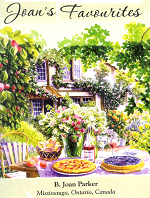 $15 plus $5 postage: B. Joan Parker 2028 Ambridge Court Mississauga, Ontario CANADA L5J 1S2 Phone: 905-822-2278 |
||
|
2010 February 4 — Peter Rezansoff in Vancouver Sun news BETTER RENTS: ITC Construction Group president/ CEO Peter Rezansoff, 70, is pleased that rents will be an accessible $675 for the 270-square-foot "microlofts" in the Downtown Eastside's Burns Block redevelopment. The rate was made feasible by ITC and John Stovell's Reliance Properties subsidizing the abandoned five-floor heritage building's revival to the tune of $1 million. Their social-entrepreneur partnership also saw trades and suppliers participate. "We have to do something," Rezansoff said regarding homeless-ness and unaffordable housing. "Why don't we band together now the market is low and create something? Anything that is done in housing is a step in the right direction. "But," regarding his and Stovell's participation, "to achieve that, there has to be financial support." As for that low market, Rezansoff figures ITC may trim 40 per cent from its average annual turnover of $500,000 this year. One bright light, after completing its $260-million part in the Olympic athletes' village, is Reliance's $100-million tower and low-rise development at 1400 West Pender St., where ITC has now built 28 of 30 floors. Along with Vancouver architects, engineers, other builders and sub-contractors, ITC developed rapid highrise construction techniques with cranes that grew from 2,000-to 10,000-pound capacity. He's amused when developers in Portland and Calgary say casting floors every four or five days "cannot be done." He's done plenty — 15 in Coal Harbour and a forest around False Creek-Yaletown for Polygon, Qualex-Landmark and Wall Financial, not to mention being "the go-to people when Concord [Pacific] was too busy to do its own." ITC also built the Granville-at-Dunsmuir Hudson for Rob Macdonald and Peter Wall. Rezansoff relishes ITC's seven-year rating (by Deloitte, CIBC, National Post and Queen's School of Business) as one of Canada's 50 best-managed companies. That was a dream in 1983, when his and Anton McGill's new, 12-employee Intertech Construction contracted to build the Richard Henriquez-designed Sylvia Hotel tower for owner-developer Norm Sawyer. Progressive business record aside, Rezansoff has some old-fashioned ways. Born into a five-sibling Doukhobor family in Nelson, he literally lives above the store. He and wife Elsie, who'll celebrate their 50th anniversary Friday, occupy what was to have been a restaurant in the Howe-at-Pacific Discovery development ITC built in 1989. His commute is 10 seconds along a tiled terrace. More ITC departments occupy the floor below. As for roots, pacifist Rezansoff is involved in a $200,000 fundraising for Selkirk College's Mir Centre For Peace at the Kootenay and Columbia River confluence. At Yasnaya Polyana in Russia, he and late Kootenays bakery-chain owner Alix Jmaeff funded a bakery-cafe [Friends of Tolstoy Project, Sponsors] to give the Leo Tolstoy museum a reliable income. The act was a partial payback for revenues from the author's The Resurrection aiding emigrating Doukhobors. "You need a little ongoing business to create some returns," Rezansoff told museum operators, "so you don't have to want for handouts." Others in the development-construction industry might heed that for our Downtown Eastside. Tribute to Peter Rezansoff (1939-2021) |
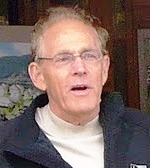 Peter Rezansoff 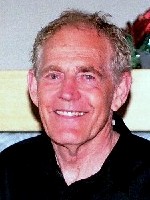 Peter Rezansoff at his summer home on Christina Lake, B.C., 2006, by K.J. Tarasoff. Biography: "People's Builder and Culture Mover", Spirit Wrestlers: Doukhobor Pioneers' Strategies for Living (2002), pages 203-205. This article has been copied on the Internet many times. "Builder proud that partnership produced affordable rent in Downtown Eastside", Vancouver Sun, February 4, 2010. |
||
|
2010 February 4 — 'Neither War Nor Silence', by Carolyn Zonailo Carolyn Zonailo is an accomplished poet, editor, writer and consultant from Vancouver, British Columbia, with a Doukhobor heritage. She attended college in the US, then received her B.A. in literature from the University of British Columbia (1971) and M.A. from Simon Fraser University (1980). She published eleven books of poetry and several chapbooks. Her papers are archived in the Special Collections ad Rare Books at the W.A.C. Bennett Library, Simon Fraser University. Her most recent article 'Neither War Nor Silence', published December 12, 2009 in Poetry Quebec, is a breath of fresh air in writings about Doukhobors. It is accurate, balanced, well-composed; it's a short narration of who Doukhobors were in history and today. She writes that Doukhobors are totally against war. However, because of their conscience and the idea of the spirit of Love or God in everyone, they will not be silent. They must speak out for a nonkilling society, for gender and social equality — for a belief in love. As the author correctly and appropriately states, 'These ideas, though radical at the time of their inception, have increasingly become relevant in today's global culture'. The article ends with two poems. The first about war in Afghanistan; and the second about murder and destruction at the hands of Islamist militant terrorists in Mumbai in November 26, 2008. |
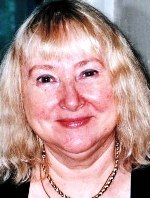  Her book The Land of Motionless Childhood includes memories of her Doukhobor family. |
||
|
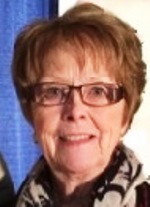
2009 December 10 — Audrey Horkoff Receives Prestigious Citizenship Award Because of her involvement and work in the Saskatchewan community of Kamsack and beyond, Doukhobor-born Audrey Horkoff was amongst the district's most celebrated residents. On December 6, she was presented with the Garden of Saskatchewan Citizenship Ring. Ruth Cooper who nominated Horkoff said of her: 'Audrey finds time to do special acts of kindness.... She seems to see one's needs before one is even aware of them. Her acts of kindness are done in such a quiet and caring manner that they often are not obvious. 'One can always count on her....She makes a commitment and keeps it, is always there when she says she will be and her contributions are always worthwhile.' As a young parent, Horkoff, who now farms with her husband, Don, took on responsibilities dealing with children, including being president of the Band Parents' Association, a leader of the 4-H club and president of the figure skating club. A parishioner of the United Church, she is a member of the church's board of trustees and serves on several church committees. Horkoff has received a number of awards and recognition for her work, including: being named breeder of the year by the Saskatchewan Charolais Association in 1985; an honourary lifetime membership with the Saskatchewan Association of Agrologists in 2000 for work done in agriculture in the province; a recipient of a certificate for volunteer work from the Town of Kamsack in 2005; a recipient of the Lieutenant Governor's Centennial Medal in 2005; and being selected as one of the 'Women of Influence' in 2005. (Kamsack Times, December 10, 2009:1-2). And, Agriculture Hall of Fame inductee 2009, Downtown Action Plan Committee Member. ("Local Heroes" Kamsack town website) |
 |
||
|
2009 December 3 — Mary Fofonoff a "Saskatchewan Women of Influence" When the Saskatchewan Women of Influence exhibit was created by the provincial government in 2005, 87 women were recognized including Mary Fofonoff of Verigin, Saskatchewan. Now, a museum group has taken up the challenge of converting the exhibit into a hardcover book entitled Saskatchewan Women of Influence: 1905-2005, to be published in May 2010. Fofonoff died in September 2004, abut the same time the Women of Influence panel was being created. The following June during the official opening of the National Doukhobor Heritage Village at Verigin, the panel dealing with her was officially unveiled. Fofonoff often became the representative of Doukhobor culture who welcomed visitors, including Queen Elizabeth II to Verigin and the heritage village. She was a true community-spirited person who gave of herself generously to such work as 4-H club and the New Horizons seniors' centre as well as the heritage village. For the 1995 Doukhobor Centennial, she coordinated the making of a commemorative quilt created by Doukhobor women from around the world. Laura Verigin of Benito, Manitoba said of her: 'We are richer, having had her in our midst.' (Kamsack Times, December 3, 2009: 13). She worked hard to keep the Doukhobor culture alive. |
|||
|
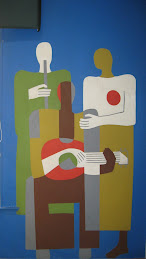
2009 September 28 — Perehudoff's Murals Will Be Salvaged in Saskatoon, Saskatchewan Due to news in March announcing destruction of one of Saskatoon's landmarks, advocates volunteered to save them. The Saskatoon City Council tonight contributed $25,000 towards the $80,000 needed to save the Perehudoff murals at the old Mitchell's plant before the building is demolished. Dave Denny and Lynn Earle have been instrumental in coming up with a solution to save the murals where most others have said it would be impossible, through the application of codfish oil of all things. An excellent website is devoted to the project with good photos: Mendel's murals.
|
 |
||
|
2009 July 23 — Corrrections for 1977 book about Doukhobors: The Hope and the Promise In 1978, John A. Popoff of Yorkton, Saskatchewan submitted the following corrections to Hugh Greig's book: The Hope and the Promise: the tender, tragic and often brutal story of the Doukhobors.
|
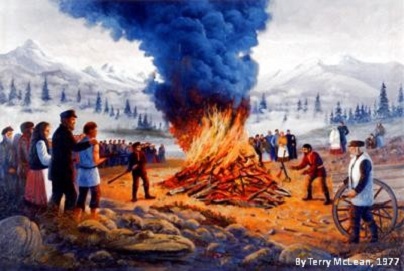 Terry McLean painted the book cover image |
||
|
2009 March 27 — Perehudoff's Murals Can't be Salvaged in Saskatoon, Saskatchewan On March 26, 2009, the Saskatoon StarPhoenix published a story about the planned demolition next year of the former Mitchell's Gourmet Foods meat processing plant because a street needs to be extended. In the 1950s William Perehudoff worked at the plant, and was an emerging artist. On the walls he painted abstract silhouettes of human figures, two guitars, a bass violin, a brush and a palette. The panorama was commissioned by Intercontinental Packers founder Fred Mentel in 1953 and today is appraised at $200,000. For two years efforts to assess whether the frescoes could be salvaged have yielded only negative reports.
|
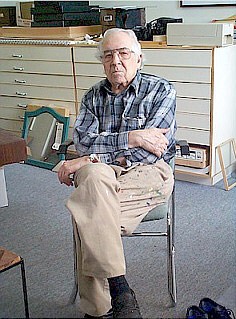 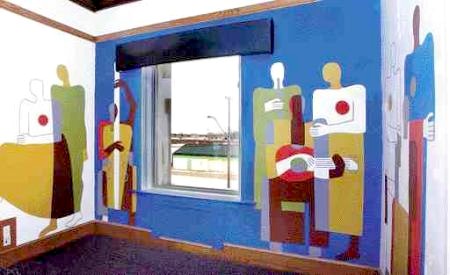 Saskatoon artist William Perehudoff painted the executive suite at the former Mitchell's Gourmet Foods plant |
||
|
2008 September 11 — Chef "Uncle Bill" Anatooskin in the News Burnaby, BC — The Newsleader reports: "Like mom made: Bill Anatooskin grew up watching his mom work in the kitchen, and paying attention paid off", story below and photo right, followed by his featured recipe: "Uncle Bill's Deep Fried Zucchini Strips" shown in the photo. "Bill Anatooskin or Uncle Bill, as he likes to be called, calls himself a master chef but not a professional cook. A resident of Brentlawn Drive for 54 years, Bill's mom taught him to cook — who was a "bit of this, a little of that kind of cook. Eventually he started anayzing her methods and writing down her recipes. "I even later on taught my mother to cook," he remembers with a laugh. As a chef, Bill has appeared on TV and radio many times, done demonstrations everywhere from Galloways to Barnes and Noble Books in the U.S., and catered all kinds of events including a feast for more than 100 seniors at the Armouries in New Westminster a few years ago. Bill has recently expanded his horizons, as he has been developing recipes for a cooking website called recipezaar.com where he has more than 345 recipes on-line. Between that, marketing his recipe book From Uncle Bill's Kitchen, and enjoying life with Jackie, his wife of 35 years, it's a good, busy life for Uncle Bill." |
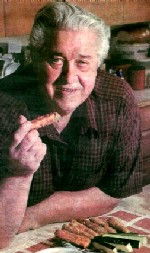 Uncle Bill's Kitchen is offline, but saved by Archive.org |
||
|
2008 August 27 — Ashleigh Androsoff does PhD thesis on Doukhobors Ashleigh Brienne Androsoff from Burnaby, BC, expects to finish her PhD next year in history at the University of Toronto. She uses the Canadian Doukhobors as a case study of how collective memory and assimilative pressure impact group identity formation. In the past 2 years she contributed 5 documents to Doukhobor scholarship. UPDATE: 2011 — Spirit Wrestling: Identity Conflict and the Canadian “Doukhobor Problem,” 1899-1999. PH D dissertation by Ashleigh Brienne Androsoff, Department of History, University of Toronto, 2011. 2008 June Paper — "Tell Us a History: Doukhobor-Canadian Narrated Identity" (Congress of the Humanities and Social Sciences, Annual General Meeting of the Canadian Historical Association held at the University of British Columbia in Vancouver, B.C., 31 May to 4 June 2008; Session 35.1 "Telling Stories: Politics, Identity, and Oral Histories") 2007 May Paper — "From the Private Sphere to the Public Eye: 'Redressing' the Image of Doukhobor- Canadian Women in the Twentieth Century" (Congress of the Humanities and Social Sciences, Annual General Meeting of the Canadian Historical Association held at the University of Saskatchewan in Saskatoon, SK., 26-30 May 2007; Session 34.1 "The Immigrant Experience in Canada and Australia) 2007 April Paper — "Assimilate and Become Canadians!: The ABCs of the New Denver Residential School for Sons of Freedom Children, 1953-1959" (British Columbia Inner and Outer Worlds Conference; co-hosted by University College of the Fraser Valley and the Stó:lo Research Management Centre held in Harrison Hot Springs, B.C., 27-29 April 2007; Session 1.3 "Culture: Perspectives and Conflict") 2007 Publication — "A Larger Frame: 'Redressing' the Image of Doukhobor-Canadian Women in the Twentieth Century" Journal of the Canadian Historical Association 18 no. 1 (2007): 81-105. 2006 March Paper — "Doukhobor History-Telling: Identity Through Narrative" (Politics of Memory Conference held at the University of Toronto in Toronto, ON., 31 March to 2 April 2006; Session 1 "Canada Recalled") 2004 Award — 'As Prime Minister Award', with a sizeable scholarship, a paid internship, and the opportunity to put her ideas forward to the PM and MPs. Beginning in 2006 this contest was televised as Canada's Next Great Prime Minister. |
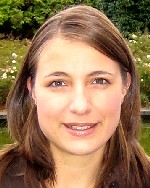 Ashleigh Androsoff BA 2001 Simon Fraser Univ. MA 2002, PhD ~2009 University of Toronto Proposed dissertation: “In Collective Memory and the Public Eye: Narrative, Identity, and the Canadian Doukhobor, 1899-1999”. Title changed in 2011. |
||
|
2008 June 29 — Doukhobor Peace Day in Calgary Held in Backyard Jack and Jan Tarasoff were hosts of an unusual Annual Doukhobor Peace Day (Petrov Dien) in Calgary, Alberta. Some 20 people responded. They came to the house and transformed the sunlit backyard into an outdoor sobranie gathering. Tables, chairs, food and drinks were brought out into this home setting as those gathered recalled the special historic event that stretches over a century back to another continent. It was an event like no other that captured the imagination of many. Normally this celebration is held at the Doukhobor Home in Lundbreck. However, Micheal Verigin the long-time chairman of the Alberta Doukhobors resigned at a meeting on June 14 and the new administration headed by chairman Larry Salekin and vice-chairman Joe Faminoff decided against the use of the building for this purpose. So what were people to do? A retired professor in adult education, Jack is now the new secretary of the Council of Doukhobors in Canada. |
At the Calgary backyard, Mabel Stoochnoff spoke about Matthew Lebedoff, the first Doukhobor who is remembered as the brave fellow in a military battalion to lay down his gun at the Easter celebration in 1895. Ten of his brethren followed his example and all were punished in a disciplinary battalion and then exiled. Then in June, under the inspiration of Peter V. Verigin who was already in Siberian exile, the historic arms burning event proceeded. The rest became history. |
||
|
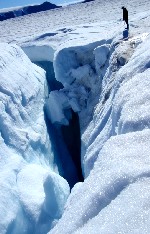
2008 June 28 — Dr. Lev Tarasov Measures Global Warming 'Lev Tarasov, who is intrigued by planet-altering meltdowns, has a novel "plumbing" inspection planned for July. A helicopter will drop him near a five-kilometre-long crevasse field on the Devon Ice Cap [Devon Island] in the Canadian Arctic. He and his partner will set up camp and venture off to measure the icy chasms that produce the icebergs peeling off a glacier and crashing into Baffin Bay. ... "We're trying to find out what the plumbing's like in an ice sheet," says Tarazov, a glacial physicist at Newfoundland's Memorial University, who is heading north as part of an ambitious international project. ....'
|
 |
||
|
2008 July 12 — Pioneer Bibliographer Dies Maria A. Horvath (nee Krisztinkovich) was the author
of A Doukhobor Bibliography
Based on Materials Collected in the University of
British Columbia Library, Vancouver,
British Columbia — "The
most
complete archival collection in North America, with
many Russian-language source documents." When she
left the University in 1972, Jack McIntosh took over the
work and has since continued to revise and expand this
monumental task as an Annotated Bibliography. The work
is ongoing and updated
on the Internet. The original author died in July
2008 at the age of 90, after a courageous 35 year battle
with cancer. Available from Amazom.com.
|
|||
|
2008 July5 — Partnership to Expand Family Research Online "Library and Archives Canada (LAC) and Jonathan J. Kalmakoff, creator of the Doukhobor Genealogy Website, the largest Doukhobor family history website, announced today a strategic partnership to make more resources accessible to Canadians interested in online Doukhobor family research. ... material, covering 1899 to the present, includes thousands of government records, private manuscript collections, books, reports, periodicals, newspapers, photographs, and sound and video recordings. The result will be a thematic guide to help locate the material and assist in general research. ... free of charge ..." |
 Library and Archives Canada and Doukhobor.org to unite. |
||
|
2008 February 23-24 — Restructuring Committee Formed on the Future of the USCC At the USCC Annual Convention held in British Columbia February 23-24, 2008, a special Task Force 'Restructuring Committee' was established to revitalize the organization and stem the tide of membership loss so as to 'reaffirm our Doukhobor identity, vision and commitment in the 21st century'. A total of 13 members (right) have been selected, representing USCC membership from Alberta to the Pacific Ocean. Additional youth members are still to be added. The Committee was set up at the time that the Union of Spiritual Communities of Christ (USCC) marked its 70th birthday this year which is also the centenary of Doukhobor life in the province of British Columbia. Its mandate is to present a plan for approval at the 2009 Annual Convention. Four problems cited in an Open Letter to all USCC members (Iskra, July 4, 2008: 45) :
|
How can we restructure the USCC to attract membership? Send your ideas to: USCC Renewal Task Force, c/o the USCC Office, Box 730, Grand Forks BC VOH 1HO email taskforce@iskra.ca (subject line: "Task Force"). Members of the Task Force are: J.J. Verigin, Jr. spokesperson; David Sokaveiff, chairperson; Jim E. Popoff, secretary; Peter Repin, vice- chairperson; Eileen Kooznetsoff, vice- secretary; Gordon and Vi Bondoreff and Bonny Strukoff, BC West Coast organizers; Joe Cheveldave, Okanagan organizer; Joe Faminoff, Alberta organizer; Nell Plotnikoff, Lisa Poznikoff and Peter Relkoff. |
||
|
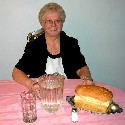
2008 January 12 — Baba's Home Cooking On Line Anne (Potapoff) Hlookoff-Kehler — Baba — announced her 50 recipes on DVDs, now you can see them online. See Baba cooking her favorite dishes on your home computer. Download any of 50 recipes on line for $2 for one play. Learn to cook and save money on groceries. "No need to pay for shipping and no need to wait for delivery!" 10 recipes are Russian dishes: borscht [borshch] (soup), lapsha (noodles), pyrahi [pirogi] (pastry), golupsti (cabbage rolls), nalesniki [blini] (crepes), haloonki [galushki] (dumplings), vinaigrette [vinegret] (beet salad), vareniki (pyrogies, ravioli). |
 |
||
|
2007 October 12 — Uncle Bill Invents 'Dilly Core' Innovative chef 'Uncle Bill" William Anatooskin of Burnaby, British Columbia is known for his Russian, Ukrainian and West Coast recipes in his famous cookbook, From Uncle Bill's Kitchen (1996). Now Bill has designed a new kitchen product called 'Dilly Core', a dill pickle corer sold with a recipe for stuffed dill pickles. Uncle Bill designed the corer specifically for dill pickles so it is much smaller than an apple corer that often destroys a dill pickle. The product includes his Flavourful Famous Stuffing Recipe in every order. The corer is made from stainless steel, 'so it is dishwasher safe and will not rust or tarnish and it cleans easily', says Bill. The cost per unit is $10 and includes all taxes and shipping costs to Canada and the United States. Delivery takes 4 to 10 days after receipt of payment. Order from Uncle Bill at wanatoos@shaw.ca. See Koozma's book Spirit Wrestlers: Doukhobor Pioneers.... (2002), pp. 267-268 for a feature on 'Uncle Bill's Culinary Creations'. It was Bill's late mother Margaret, who as an excellent cook with a wide repertoire of tasty dishes, influenced Bill to develop a passion for cooking at a young age. However, it was only at the age of 63 that Bill gave up his profession as builder and manager of multimillion dollar construction projects to take up his favourite passion of becoming a master chef of many tantalizing and healthful meals. See his recipes online. See article "Like mom made", September 11, 2008, Newsleader (Burnaby, BC) |
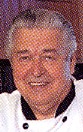 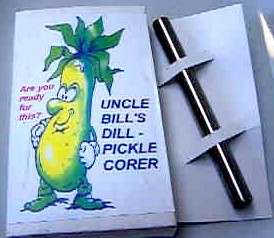 Click to enlarge. 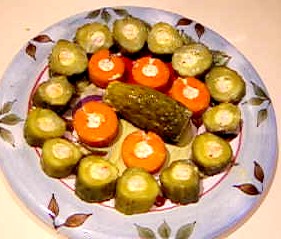 |
||
|
2007 May 26 — 'Doukhobor Place Names', Univ. of Sask. Jonathan J. Kalmakoff will present his research paper 'Place Names of Early Doukhobor Settlements in Saskatchewan, 1899-1907', at the 41st Annual Meeting of the Canadian Society for the Study of Names, during the 76th Annual Congress of the Humanities and Social Sciences, held at the University of Saskatchewan in Saskatoon. Jon speaks at 10:20 a.m. to 12:20 p.m., Saturday May 26, Room 100, Arts Building. See: Doukhbors Featured at the Congress of the Humanities and Social Sciences, Release, June 3, 2007, Doukhobor Genealogy Website. Jon, host of the Doukhobor Genealogy Website, will focus on the names of early Doukhobor settlements in Saskatchewan, 1899-1907; Doukhobor place naming, beliefs, collective history and world view; geography, settlement patterns and land use; Russian language and orthography; and types of Doukhobor place names according to their meaning and mechanism of origin. All are invited. |
 |
||
|
2007 May 26 — Mark Zeabin makes casket furniture Who says you can't take it with you? By Regina and Douglas Haggo, The Hamilton Spectator, Hamilton, Ontario Here's a guy who thinks outside the box. Mark Zeabin started making coffins 10 years ago, after his grandmother died. A Canadian of Russian Doukhobor heritage, Zeabin was proud of his craftsmanship, but bothered that his fine work had to be buried. Then he had a brainwave. Since his caskets couldn't be appreciated afterward, perhaps they could be enjoyed before their end use — in a slightly different form. Zeabin started making furniture that could function as final resting places. He crafts beds, sofas, display cases and end tables that can be turned into caskets when the time comes. The family business in Crescent Valley, B.C., near Nelson, has a website, casketfurniture.com, which reveals that a sofa or coffin/coffee table will set you back $3,995 US. For $5,995 US, you can have an "eternal-tainment centre" that "transforms easily into a his-and- hers casket combination." |
 |
||
|
2007 May 25 — Borderlands Cultural Focus, Seattle WA Panels, Stories, and Performances from the 49th Parallel. The 2007 Cultural Focus is Borderlands, a presentation of the extraordinary arts, artists, customs and traditions in border communities of the Pacific Northwest. Meet artists, musicians, dancers, craftspeople, smokejumpers, packers, border guards, water-witchers and yodelers from both sides of the US-Canadian border at the 2007 Folklife Festival, held at the Seattle Center. Of the 14, these are named on the audio: Andrei Bonderoff, Harry & Florence Hadikan, Andrei Sherstibetoff, Johnny Popoff. Hear the 14 minute audio presentation in MP3 format. |
 14 Doukhobor singers talk about the connection between Doukhobor heritage, pacifism and song |
||
|
2007 May 22 — 86 of 112 Canadian Doukhobor Cemeteries online The Doukhobor Cemetery Transcription Project, an ambitious project launched in 2004 and headed by Jonathan J. Kalmakoff to document and transcribe all 112 Doukhobor cemetery and burial sites across Canada, is entering its third and final year. To date, 86 cemetery transcriptions are complete and available online, with the remaining twenty-six in progress. To learn how you can contribute to this worthwhile heritage project, visit the Doukhobor Genealogy Website. |
 |
||
|
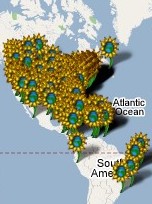
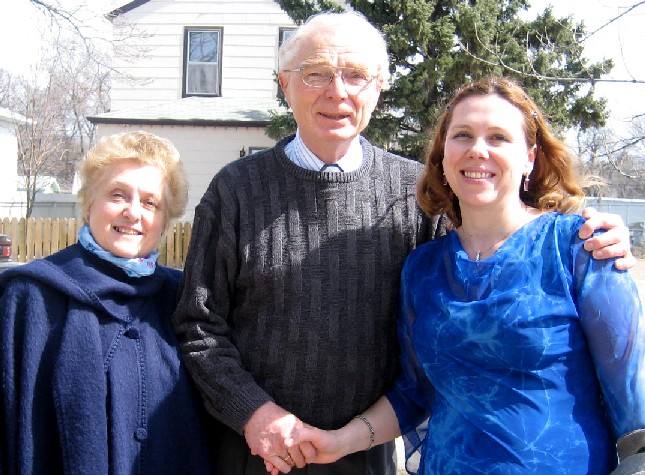
2007 April 14 — Variety Night in Saskatoon Saskatoon Doukhobors joined 349 peace groups around the world in a month-long series of musical peace celebrations leading to a Global Wave of Music on April 22, 2007. The international peace event was hosted by the United Nations, Global Youth Services Days, Earth Day Network, Nobel Peace Prize laureates, young musicians around the world, the Albert Schweitzer Fellowship, New England Conservatory, Longwood Symphony Orchestra, and International Physicians for the Prevention of Nuclear War, and Harvard-affiliated Beth Israel Deaconess Medical Center in Boston. Mae Popoff organized the Variety Night and registered it on the website: www.reverenceforlife.org. Participants are shown with a sunflower placed on a global map. Click on map, right. Also see: www.myspace.com/reverence4life. Here is a note recieved by event organizer Mae Popoff on April 4: Thank you for registering
your event with Reverence for Life — "Music for Life".
A
sunflower has been placed on the map for you, our
very first in Canada! You are helping the wave to grow!
Please pass the word along about peace. We are very much
looking to add additional events in Canada. Thank you!
Amanda E. Daly
Global Coordinator, Reverence for Life/"Music for Life" Albert Schweitzer Fellowship, Boston, MA VARIETY NIGHT at the Doukhobor Society of Saskatoon On April 14, 2007 folks gathered in peace, and global community for song, dance, and entertainment to celebrate another Variety Night. After the words of welcome offered by Wm Woykin and Mae Popoff, the program started with the Saskatchewan Doukhobor Choir who sang to “honoring Peace and Freedom” with universal applications. Our souls were touched with the solos, gospel songs, yodeling, duets, family entertainment, humor, humanitarian soul connectedness, travel distances, accordion and guitar accompaniments. There were a record number of guitars!!!(10+) The Russian Dance Group from Calgary were a special highlight with the four seperate appearances and costume changes. We appreciated Alex Kalesnikoff and his efforts for the Russian Dance Group appearance. Please come again. The audience was most appreciative and showered the entertainers with applause and requests for more favourites, like the Auctioneer Song. Special compositions honored Bill Woykin and his consistent efforts to bring the spirits of welcome to all. As the Saskatchewan Doukhobor Choir sang the farewell hymn, the activities downstairs geared up with pie, coffee, laughter, connections and memory building. Whatever geographic location, heritage, ethnicity, or country of origin, the folks at the Saskatoon Doukhobor Variety Night were representative of celebrating peace through love and musical connections. Together, we are better!!! Submitted by Mae Popoff,
Saskatoon — May 14, 2007 (Also sent to DOVE)
|
 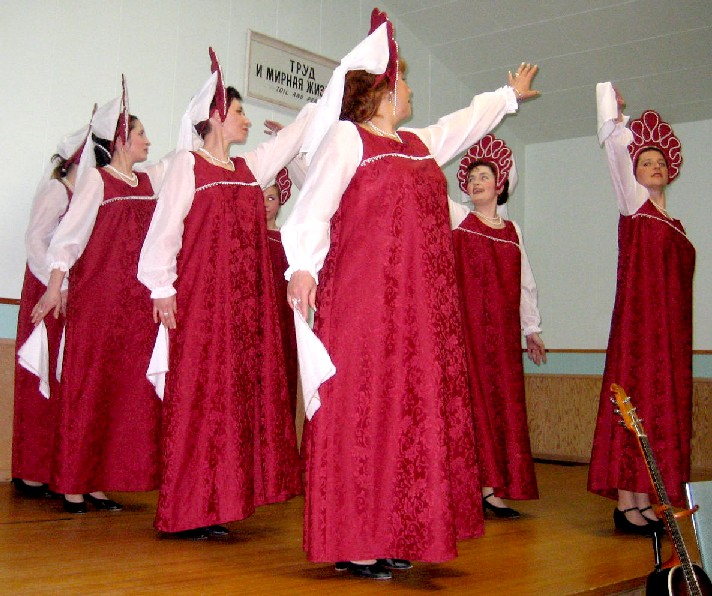 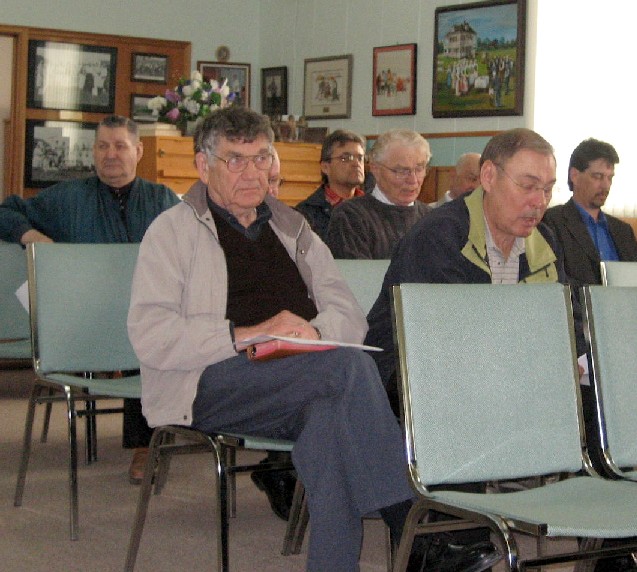 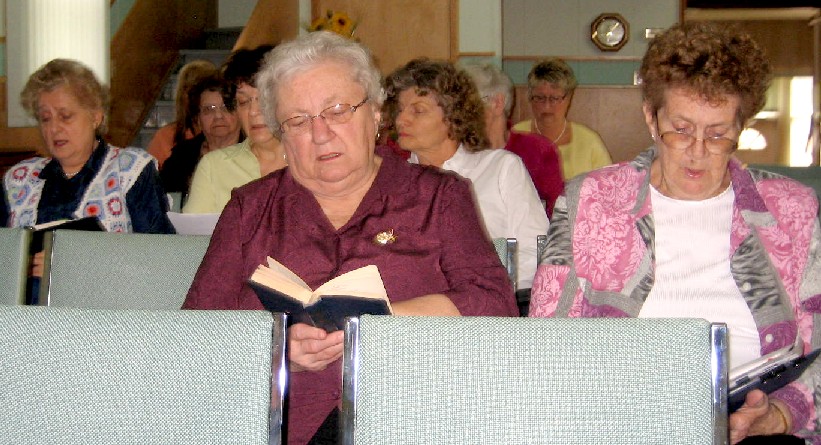 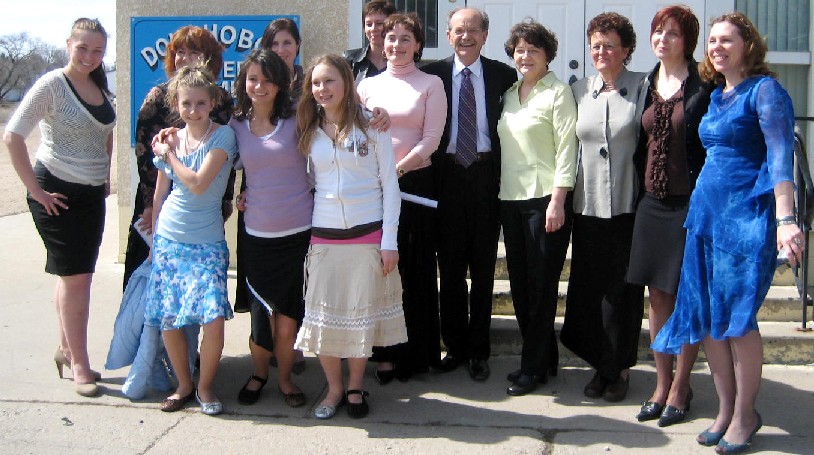  |
||
|
2007 April 11 — Lena Sherstobitoff MA Thesis: Doukhobor Language "Flowers and Weeds: Negotiating the Contemporary Doukhobor Diaspora" by Lena Sherstobitoff, Simon Fraser University, MA Thesis May 2005 (Supervisor: J. Rak) — Contemporary Canadian Doukhobors are facing a situation where a significant segment of their populations do not speak the Russian dialect of their predecessors. Consequently, English translations and substitutes are becoming increasingly popular, even necessary. Although these translations are direct evidence of Doukhobors' assimilation into Canada, Doukhobors have not entirely forsaken their connection to a Russian ancestry. The investigation of this subtle negotiation between here and homeland will be facilitated through personal interviews with contemporary Doukhobor youth. — Abstracts, 49th Annual Conference, Western Social Science Association, Calgary, Alberta Canada, April 11-14, 2007, page 174. |
|||
|
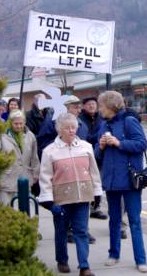
2007 March 17 — Iraq War Rally, Castlegar The Kootenay Region Branch of the United Nations Association in Canada together with the USCC Working Group on Peace and Justice held a march and rally on Saturday, March 17 to mark the start of year 5 of the invasion and occupation of Iraq. About 75 people marched from Stephenville Square to the Castlegar Courthouse where the programme was conducted. People made placards or carried a traditional Peace Dove. The rally attracted about 25 people to join in. About 100 people listened to the speakers and Music: J J. Verigin Jr., Jayme Hadikin, Leonard Voykin, Alex Atamanenko, KRUNA/USCC members, Robson Community Choir, and others. |
 |
||
|
2007 February 23 — New Vancouver Doukhobor Organization — VIDCA V.I.D.C.A. stands for Vancouver Island Doukhobor Community Association, not Cultural. It seems a lot of people have this wrong. Not a big deal, but should be clarified, since we are a registered Society in BC, and have been for nearly 15 months now! Also, our Victoria Doukhobor Choir Concert is on Saturday, April 21. Watch for our ad in the ISKRA! VIDCA is donating the proceeds to orphanages in Khabarovsk and Vladivostok, Russia. Submitted by Johnny Popoff
|
|||
|
2006 December 14 — Additions to Doukhobor Genealogy Website Jonathan Kalmakoff, a Regina Saskatchewan lawyer and Doukhobor genealogist and historian, just added dozens of new pages to his extensive Doukhobor Genealogy Website:
|
|||
|
2006 December 13 — Dr. Lev Tarasov gets Canada Research Chair As of January 2007, Lev Tarasov — theoretical physicist, social thinker, teacher, sportsman, and my son — has been appointed for a Tier II Canada Research Chair in Modeling Climate Dynamics, Memorial University, Newfoundland, Canada. See his academic website, especially his pages on: Strategy for Social Change, Some Thoughts on Pedagogy, and Wilderness Sports, which reflect Lev’s philosophy. We named him after Lev N. Tolstoy. Years ago he changed his surname from Tarasoff to Tarasov "to be close to the original roots". — Hear Lev's interview on the radio show: "On The Go", CBC Radio, aired Thursday Mar 15, 2007 (13 minutes, Real Media format). As the world warms up, and the glaciers retreat, the seas will rise? But by how much, and when? And what forces will drive that change? |
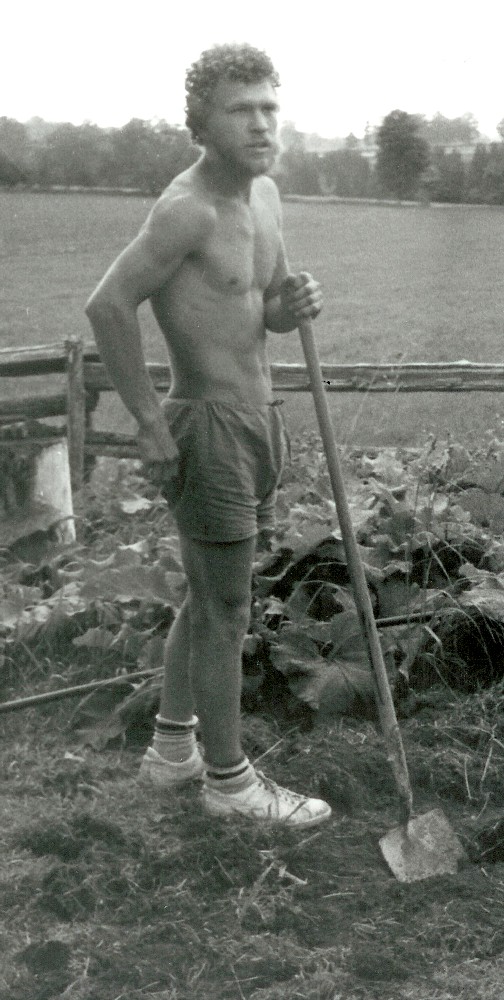 Lev Tarasoff, on farm near Guelph, Ontario, May 31, 1987. |
||
|
2006 December 7 — Doukhobor Novelist Vi Plotnikoff (1937-2006) Dies "Violet Plotnikoff, author of the book Head Cook at Weddings and Funerals, passed away on November 20, 2006. Vi was born on a farm near Veregin, Sask. and was the first of seven daughters born to Annie and Ignace Makaeff. When Vi was very young, the family moved to Grand Forks, BC where they settled In 1958, Vi married Serge Plotnikoff and in 1959, they moved to Castlegar, where they have lived for the past 48 years and raised two sons, Ron and Larry. Vi worked as a copywriter at CKQR Radio for many years. She enjoyed writing and storytelling and a dream of hers was realized when her first book, Head Cook at Weddings and Funerals, was published in 1994. Vi continued to enjoy writing and storytelling and has participated and spoken at many writers’ workshops and conferences over the past several years. Vi was particularly proud to have founded the Castlegar Writers Guild, of which she was still an active participant, and was in the process of completing her second book at the time of her illness. She was active in the Doukhobor Cultural Association for more than 38 years. Vi enjoyed her yard and her garden very much and greatly valued spending time with friends and family. Vi was predeceased by her parents and two of her sisters, Linda and Dawn Makaeff. Left to mourn her loss is her husband of 48 years, Serge; sons Ron (Kylie) and Larry (Peggy); and grandchildren: Jill, Tom, Mikisha and Alexandra. Also her sisters: Mary Persoff, Anna (Jack) Konkin, June (Curt) Whachell and Judy (Thom) Pritchard; her special aunt Vera Makaeff, and numerous nieces and nephews. Funeral services were held November 24, 2006 at the Brilliant Cultural Centre with interment at the Park Memorial Cemetery." (From Grand Forks Gazette, Nov. 29, 2006, page19) Also see:
|
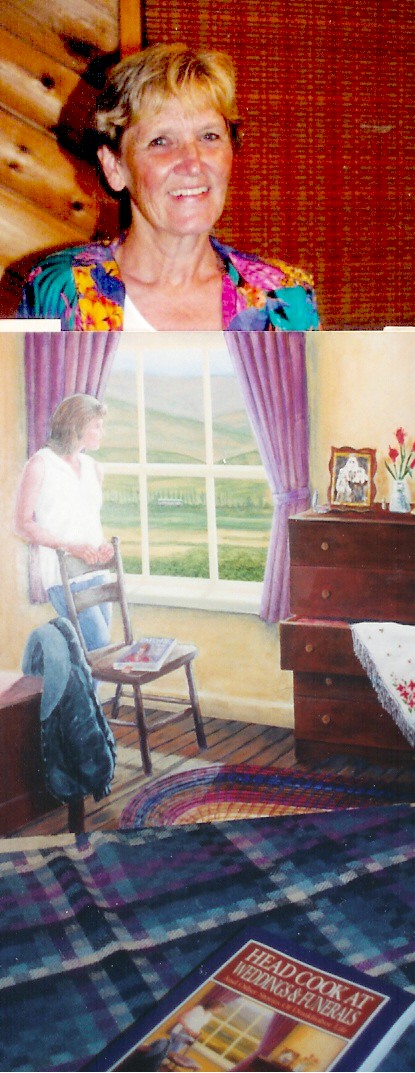 Vi Plotnikoff holds painting that she used for the cover of her first book, in her residence, Castlegar, BC, July 18, 1995. Photo No. C987_7 by Koozma J. Tarasoff. All rights reserved. 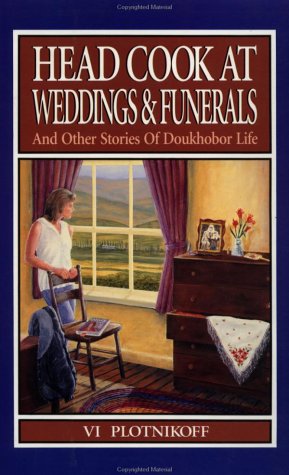 |
||
|
2006 November 27 — Doukhobor Bread in Saskatoon – August 2006 By Koozma J.
Tarasoff, November 27, 2006.
The 2006 (August 8 through 13) baking and selling of loaves and slices of Doukhobor bread during the Saskatoon Exhibition Week was again a great success. The week-long Exhibition at Prairieland Park brought thousands of visitors to the Doukhobor booth. Here three brick ovens and a staff of volunteers worked day and night to keep the fires going, the bread dough flowing, and the loaves being baked in the ovens in the manner of their grandparents a century earlier. The technology was similar. A fire was lit inside the brick ovens, then embers were removed. The ovens stayed hot enough to bake the bread until the next round. Bread-baking in the City began in the mid-1950s when the Doukhobor community built its Community Home in the West end. At first brick ovens were built on the grounds of the old Western Development Museum. However with the relocation of the Museum to the City’s Exhibition Site, the Doukhobors moved its facility there as well. Each set of three ovens produced approximately 100 loaves at a time. This year, at least 1200 loaves were baked each day. A total of 175 bags of flour were consumed during the week.. Each loaf was sold at $4 Canadian or $1.50 per slice with butter and jam. All proceeds from the event went to charities and the Doukhobor Society. It is a labour of love. Inspiration for this very successful community project comes from the bread, salt and water as the basic staff of life. And the taste is terrific. It is superior to ordinary bread from the supermarket because it tastes like bread should. Notes: See article by George Stushnoff ‘Doukhobor bread-baking in Saskatoon: a success story’, in Koozma J. Tarasoff (compiler and editor), Spirit-Wrestlers’ Voices: Honouring Doukhobors on the Centenary of their migration to Canada in 1899 (Ottawa: Legas, 1998): pp. 145-153. The article states the basic facts and figures about bread-baking in the City along with a layout schema of the baking complex. For example, the first batch of bread from the old clay oven produced by the Saskatoon Doukhobors was in July 4, 1955. The book is still available for sale. And see Mae Popoff's article below: 2006 October 7 — Doukhobor Bread For Sale. |
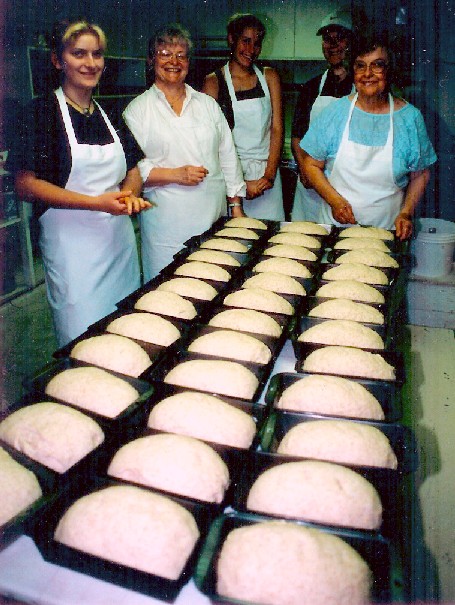 Breadbaking in Saskatoon July 12, 1999. By Koozma J. Tarasoff. All rights reserved. |
||
|
2006 November 21 — A Word from the Director, Andrew Donskov, F.R.S.C. From the Slavic Research Group
Prospectus 2006, page 3
The Slavic Research Group at the University of Ottawa is proud to celebrate its eighth anniversary with the appearance of Prospectus 2006, which we hope will make our work and output better known among the academic community in Canada and abroad and our own community of students, faculty and administrators at the University of Ottawa. Our task involves a great deal of bridge-building — both among the Slavic cultures and among the various academic disciplines involved in the study of Slavic-speaking countries. These efforts are especially important in view of the social and political changes that have been taking place since the late 1980s in Central and Eastern Europe. They are reflected particularly in our establishing co-operation agreements with prominent scholarly institutions in Canada and abroad, including national academies of arts and sciences in Russia, Poland, Serbia and Montenegro. We look forward to broadening our outreach and activities to other languages and cultures of the East, West and South Slavic realms. We are happy to announce at this time several new and forthcoming publications which will add up to a grand total of 32 volumes (19 published to date, 8 co-sponsored in the Canada-Russia Series with Carleton University, plus 5 forthcoming). We are indeed encouraged by the excellent reviews many of these have engendered, which have more than justified our decision to base the bulk of our publishing output on archival sources, with research and documentation by leading specialists in their fields — all of which makes them especially valuable. We are also heartened by the enthusiastic reaction of the Ottawa and university communities to the many events (lectures, exhibits and special programmes) offered by our Group over the past eight years. We look forward to continuing outreach — through our activities, co-operation agreements and publications — both in Canada and abroad. |
|||
|
2006 October 7 — Doukhobor Bread For Sale Verigin, Saskatchewan Doukhobors made an official sign about "Doukhobor Bread" for sale at Verigin heritage site [National Doukhobor Heritage Village]. It was amazing how many folks stopped this Thanksgiving weekend. Tannis Strukoff said that they sold 100+ loaves on Friday and 50+ today, Saturday, even though it rained in every region. Some folks bought 15 loaves at a time. The highway sign did wonders. |
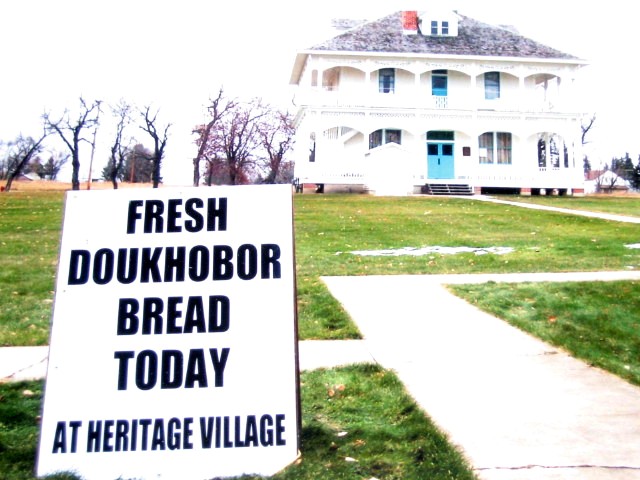 |
||
|
2006 October 5 — International Guest at the Doukhobor Dugout House When Koozma Tarasoff and guest Alexei Oslopov visited the Saskatoon region in May, 2006, they visited the Doukhobor Dugout House near Blaine Lake. As a special courtesy to an out of country guest, Brenda and Dan Cheveldayoff as well as Elizabeth Cheveldayoff provided a private tour with an abundance of hospitality, staple Doukhobor snacks ( [pirogi] "perahee" and bread) and refreshments. Alexei Oslopov was deeply moved by the authenticity and foundations of the heritage Doukhobor site. He was amazed at the architectural expertise of our forefathers who migrated to Canada at the turn of the last century. The structural styles of the buildings reminded Alexei of the Doukhobor homelands in parts of Russia. Koozma Tarasoff had the opportunity to record the visit in photographic images as did Mae Popoff who had the good fortune to be present with Koozma and Alexei. Yes, it was a "Come Home to History" time, as described in the printed brochures. |
 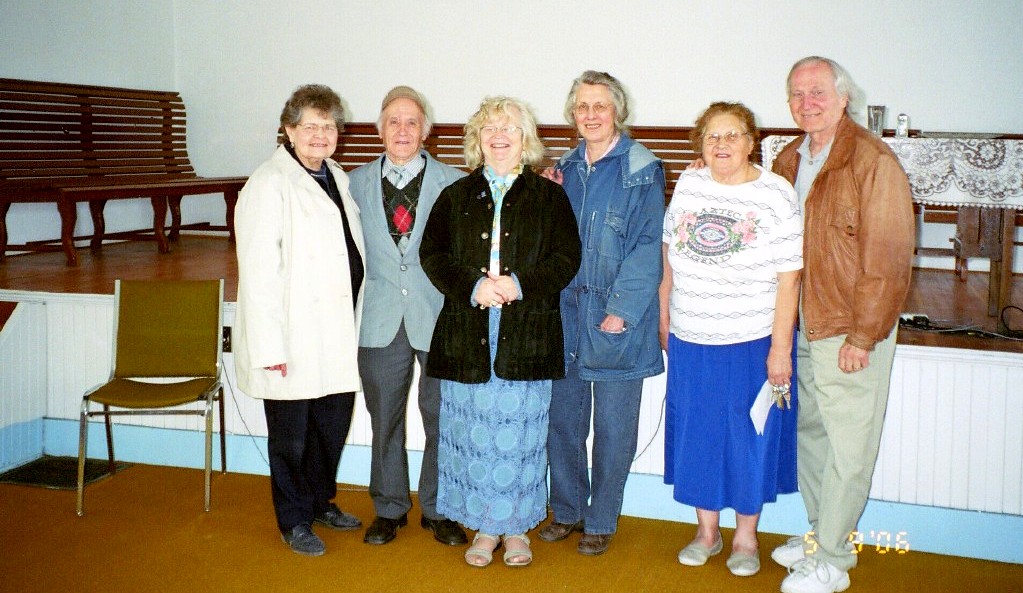 L to R: Doreen Konkin (nee Rebalkin), Alexei Oslopov, Mae Popoff, ___, Mabel Androsoff (former Mayor of Blaine Lake), and Koozma Tarasoff 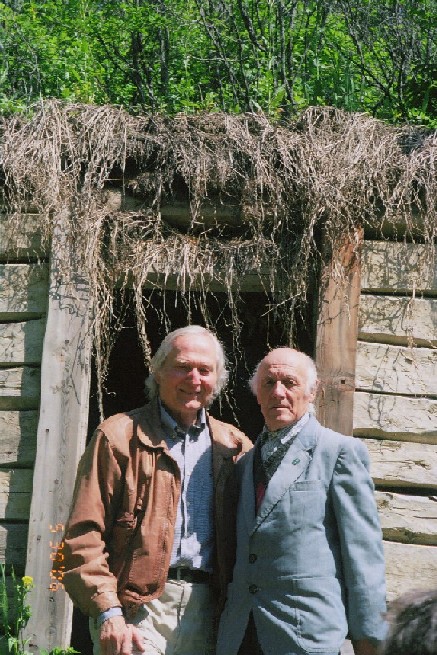 Tarasoff (left) and Oslopov at the Dugout House. 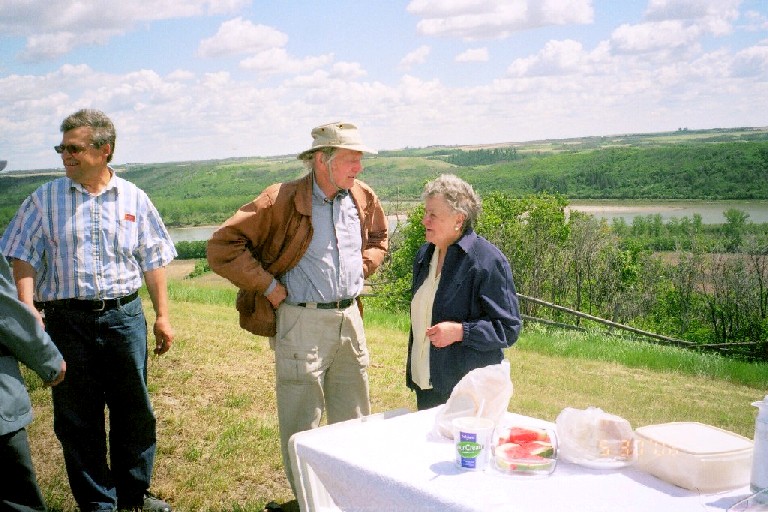 Cheveldayoff's host guests above the Dugout house |
||
|
2006 October 2 — Canadian-Soviet Friendship Society research I am researching the Canadian-Soviet Friendship Society (CSFS), its activities, and members' perceptions of the USSR, especially in the post-WWII era. The CSFS drew members and subscribers from Canadian progressive groups, including Russian, Ukrainian, Jewish and Doukhobor organizations. Individuals who would like to participate in this study will be asked to participate in an oral interview, and to sign a consent form giving me permission to use the material in my project. This project has received approval from the Carleton University Research Ethics Committee. Please contact me if you are interested in participating in this study. Jennifer Anderson,
PhD candidate
Department of History, Carleton University 1125 Colonel By Dr., Ottawa K1S 5B6 |
|||
|
2006 October 1 — The 21st Century Space Age Manifesto for Global Peace Press Release on the eve of Mahatma Gandhi's birthday and the 100th anniversary of Sathyagraha: We the concerned Scientists and Philosophers for Social Action hereby call upon the leaders and preachers of all faiths and religions, and heads of all sovereign states to abide by the Declaration of Human Rights as enshrined by the United Nations. Weapons of Mass Destruction and the suicidal bombers — both are equally destructive of human life and liberty. Please consider the millions homeless, and orphaned children turned destitute in every region due to the violent conflicts in the 21st century Space Age. Whereas powerful countries with the Weapons of Mass Destruction and with technologically advanced military-industrial establishments have unleashed global violence threatening the life and liberties of entire human civilization; less powerful cultural, and religious chauvinists directly or indirectly are involved in the war of attrition against " the other" human beings. More.... |
|||
|
2006 September 19 — Students Invited to Use the Tarasoff Archives My collection of audio-taped interviews since the 1960s includes 100s of interesting items that some day ought to be transcribed. Some of these interviews were four or more hours in length. The questions were autobiographical, historical, and sociological in nature. These are original source materials. Many of the informant have since died, but their spirit awaits someone to discover their gems of wisdom. It is a project that ought to be done, but probably requires scholarship or other financial assistance. Personally I do not know if I will have the energy or the time to do this — although it would be a great piece of work and a source of rich information. Some of the interviews were entirely in Russian, and Russian words often come up during many interviews, but fluent knowledge of Russian is not necessary for this project. These interviews can be found in the Saskatchewan Archives in Saskatoon, Saskachewan. — Koozma
J. Tarasoff, Ottawa
|
|||
|
2006 September 1 — Edmonton Oilers centre Shawn Horcoff of Castlegar, BC is now in hockey big time. In July he signed a three-year, $10.8 M deal with the club making him the team’s highest-paid forward. Find 200,000+ web pages about Shawn. Nick Verigin of Pass Creek, BC knew Shawn as a student. Nick writes: ‘I taught at the Twin
Rivers Elementary School in Castlegar, BC for five years
from September 1984 to June 30, 1989. Shawn Horcoff was
in my class and I always thought he was such a
well-behaved boy. He excelled in all sports, but he
never flaunted his superiority nor did he ridicule the
less able athletes. I was very disappointed when
Castlegar didn’t even mention the fact that Shawn scored
one of the three winning goals when Canada played
against Russia and won the gold medal a few years ago.
Castlegar made up for it when Edmonton played for the
Stanley Cup. There were signs all over saying: “Go
Shawn, Go!”’
|
 |
||
|
2006 August 26 — Spirit wrestlers keep faith alive By Darlene Polachic, The StarPhoenix — BLAINE LAKE — "The Doukhobor Prayer Home here, built in 1931, is distinguished as the only original facility that reflects the spiritual culture of Independent Doukhobors. Its members celebrated the home's 75th anniversary earlier this year. The celebration coincided with Peter's Day, which commemorates an event of great significance to Doukhobors," says Mabel Androsoff ... "That event, known as the Burning of the Arms, took place in Russia in 1895." ... Doukhobor Society of Blaine Lake is governed by a six-member board: president Alex Strelioff, vice-president Marion Burak, secretary-treasurer Doreen Konkin, Agnes Murphy, Mabel Androsoff, and Edna Androsoff. ... The anniversary service June 25 included three traditional prayers by the men and three by the women, followed by three hymns. About 150 people attended the commemoration. "Because it was Peter's Day," Mabel Androsoff said, "the songs were about the Burning of Arms. They are deeply meaningful to us because some of our relatives were exiled to Siberia and never came back." The Prayer Home, located on Main Street, is made of bricks after the Russian style. The Town of Blaine Lake has declared it a heritage building. |
|||
|
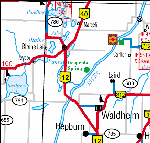
2006 August 23 — Oospenia Spring Commemorates Doukhobor Pioneers: "A spring near Blaine Lake, Saskatchewan has been officially named to commemorate the Doukhobor settlers of the area. Oospenia* Spring, the name proposed by Doukhobor researcher and writer Jonathan J. Kalmakoff, was recently approved by the Saskatchewan Geographic Names Board." It's near the Doukhobor Dugout House, a few miles south east of Blaine Lake. [Press Release submitted by Jon who created the Doukhobor Genealogy Website.] [*Also spelled Uspenia.] |
 |
||
|
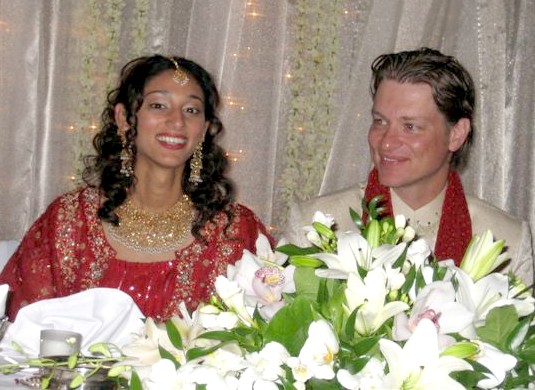
2006 August 12 — Wedding of Dr. Jeff Popoff and Dr. Naureen Wasey From international (Australia, Holland, England, United States) and interprovincial Canadian regions, with multifaith, cultural, language and ethnic diversity folks gathered at the Banff Springs Hotel, August 12, 2006 to celebrate the marriage of Jeff Popoff and Naureen Wasey doctors in love. In the reception area, Lori, sister of the groom, played wedding music on the piano. The two young nephews of the groom and many other relatives took many candid photographs. The guests assembled in the Cascade Ballroom. The bride made a spectacular entry in her wedding finery from Pakistan. The bride, the groom and their attendants sat on centre stage, facing the audience. Their parents Ateka, Mohammed Wasey and Mae, John Popoff stood behind their children on the stage. The mayor of Banff performed the marriage. During the Nikah ceremony, there were Muslim prayers, Arabic words as well as Doukhobor prayers and Russian singing to bless the future home of the bride and groom. The global community celebrated the love of the newlyweds Naureen and Jeff. During the three days of marriage celebration, with the mende, the wedding, and the barbecue, there was ethnic cuisine, like pirogi and shasliki, along with connections through dialogue, music, hugging and laughter. One could feel a spiritual presence, a sense of mutual respect, a sense of love and peace as families and friends gathered in a celebration of LOVE for the newlyweds Naureen and Jeff. The language of love was truly an interprovincial, international extravaganza at Banff Springs Hotel August 12, 2006. We appreciate all of you! Submitted by mother of the groom, Mae Popoff, Saskatoon, on September 22. |
 |
||
|
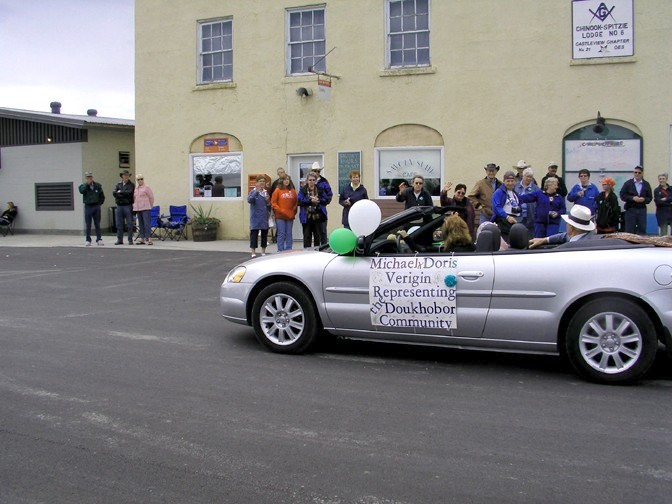
2006 August 12— The Village of Cowley, Alberta, celebrated its 100th anniversary on August 12th. The immense contribution to the development of the community by the Doukhobors was noted in the photographic displays, and in the kick off parade, Michael and Doris Verigin were featured in the parade, representing the Doukhobor community. (Submitted by Larry A. Ewashen, Curator, The Doukhobor Discovery Centre.) |
 |
||
|
2006 August 12— The town of Cowley, Alberta celebrated its 100th anniversary. This is the area where Doukhobors settled in the early part of the 1900s. Nick Verigin of Pass Creek, BC was there; he was born in Cowley. His brother Mike is still living there. Nick had an opportunity of speaking at the official opening. 'I was born in 1930, three
miles east of here. In September I started school. Dad
put me on a horse and away I went. My first teacher was
Miss Madeline Hewitt who taught me from grades one to
three. The only problem I had in school was with
sandwiches which is an English tradition. We had huge,
round loaves that were baked in brick ovens and mother
had difficulty cutting the bread into slices to make
sandwiches. After completing grade ten in Cowley I went
to Pincher Creek, staying in a dormitory as
I completed my high school in 1949.'
In public school Nick recalls playing softball, Fox and Geese, Anti-I-Over, snowballs, marbles and tag. He also had fun on the teeter totters and the swings. In those days, students were allowed to bring jack knives to school. Nick also recalls life in the town of Cowley. Electrical power came in 1941. There were rails for hitching horses when farmers came to town with wagons or horseback. A Chinese cafe was operated by Slim, a fellow who was respected by other nationalities in the area. Mrs. Christie had a store in which she displayed toys in a small room. 'To go and view the display,' said Nick, 'was equivalent to a visit to Disney Land today.' Mr. Bundy, the CPR Station Agent, was nice to the boys; he gave them Life and Weekly magazines after he had read them. There was also a pool hall, a barber shop, implement dealers, blacksmith shop and a bank. 'I don't know who used its services as no one had any money.' There was also a central telephone office and a fire hall with a hand pulled cart with a mounted water tank. 'People were poor but our
family was never hungry. We had all kinds of vegetables,
eggs and dairy products. I was hungry for candy and ice
cream. I thought that if I had an allowance of 5 cents a
week, I'd be the envy of all the children. Some people
in Cowley were poor. One boy found a piece of licorice
and said he'll wash it first. But by the time we got to
school he ate it. One time someone peeled an orange and
threw the peel away. He picked it up and ate it. I
was washing carrots in the river one day and a fisherman
came by and asked if he could have one. Children from
one family often came either early or late to school.
When the teacher asked them why, they replied: "We have
no clock." They kept time by the train. Today that
family is very wealthy.'
In August Mike Verigin visited the local burial site at Lundbreck where more than 150 people might be buried in the little plot. To reporter Jocelyn Mercer of The Boundary (August 18, 2006: 10) he observed that the history of the Doukhobor connection to the area seems almost forgotten. Michael Verigin and his wife Doris, two of the few remaining Doukhobors in Cowley today, said that back then (beginning in 1915) the Doukhobors lived much like the Hutterites today. The exception was that they each earned a personal income and would often supplement it by working outside of the settlement. ‘With the depression in
the 1930s several families left to try and make it on
their own, and in 1938 the Doukhobor creditors sealed
the end of the communal lifestyle after they repossessed
land and sold it back to individual families.
‘Out of the 300 original Cowley-Lundbreck Doukhobors, 200 decided to stay, the rest set off for BC. After the settlements disbanded, the remaining Doukhobors used fellow members’ houses to congregate, pray and hold meetings. Later in the 1950s the group built a prayer hall in Lundbreck. Today he says there are maybe a dozen in Lundbreck and Cowley who meet occasionally, at the prayer hall in Lundbreck and for funerals in the little cemetery north of the hamlet. ‘He’s spoken to the Alberta government about the possibility of preserving the prayer hall, which is the only one of its kind in the province, but because it was built in the 1950s it doesn’t qualify for heritage status. ‘Verigin has worked closely with archivists in the province, as well as private historians interested in the religion. It’s dedication like this that will mean that even when the last of the Doukhobor die out, their legacy and contribution to the development to the development of the area will remain on paper.’ |
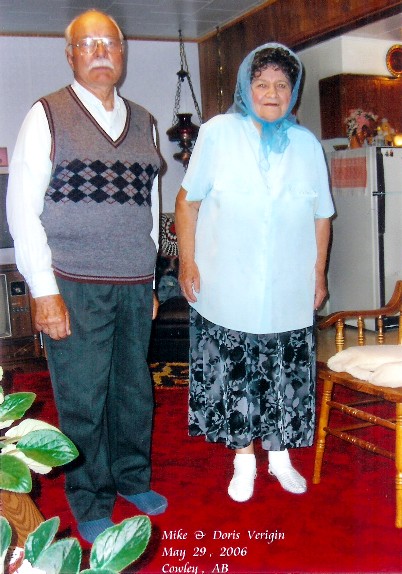 Mike and Doris Vergin in their home, Cowley, Alberta. By Vasilie Davidoff, May 29, 2006. |
||
|
2006 July 23 — Jan and Jack Tarasoff of Calgary and I visited my friends Jim and Ruth Deacove on their farm in rural Perth, Ontario. Of Doukhobor and Polish background, born in the Kamsack area of Saskatchewan, Jim is the inventor of Family Pastimes Cooperative Games (see details in my book Spirit Wrestlers: Doukhobor Pioneers’ Strategies for Living, 2002: 236-241). Based on the principle of cooperation, this home industry has had remarkable success in its 35 year history. In 1972 Jim first made a few co-op games for his own family and was encouraged by friends to make more. The games are made in small quantities as a labour of love. The format is kept simple but attractive. Today over 200 games are manufactured locally, but sold all over the world, some in several languages. One of the interesting board games, ‘Ploughshares’, was developed in the mid-1990s to commemorate the 100th anniversary of the Arms Burning by the Doukhobors in southern Russia. Jim describes the game as follows: ‘In 1895 in Russia, a
group of Christian villagers, believing deeply in Peace
and Sharing, burned the Weapons given them by the Tsar.
We become those villagers driving wagons through the
countryside, visiting homes to collect Firewood &
Weapons. We take these to the Village Center and make
Ploughshares. Watch for Tsar’s patrolling soldiers who
will confiscate our wagons and send us to prison. Learn
love and courage so, with the guidance of Wise Elders,
we will remain determined in our Cause. We might even
inspire some Soldiers to drop their weapons and join
with us. It will be an adventure filled with danger and
great rewards. To fulfill our task, we must be gentle as
a Dove & wise as a Serpent. This is a game of
collaboration, learning & discussion; a game full of
exciting strategy, with each of us making an important
contribution.’
This game will make us think about so many deep issues. To order a free catalogue, contact Family Pastimes, www.familypastimes.com |
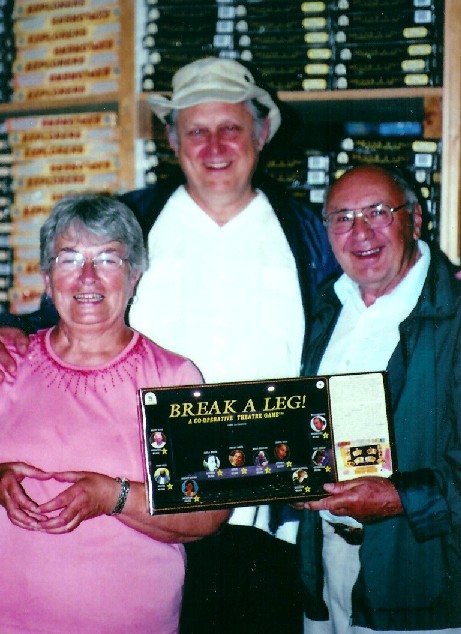 Jim Deacove (back) with Alberta friends Jan and Jack Tarasoff, displaying his ‘Break A Leg’ cooperative game at his family-based factory in rural Perth, Ontario. 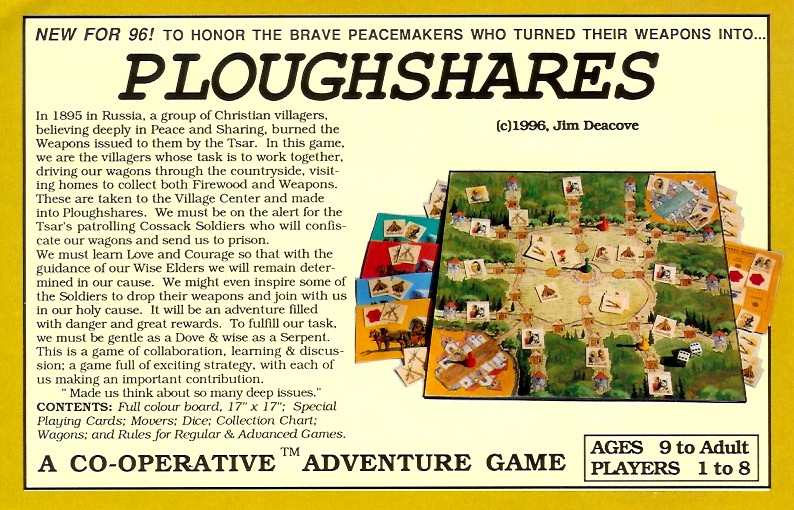 ‘Ploughshares’ cooperative game by Family Pastimes, illustrating the story of the arms burning in Russia in 1895. |
||
|
2006 July 16 — The National Doukhobor Heritage Village in Verigin, Saskatchewan is 25 years old. In celebrating this event, Laura and Peter Verigin guided a day tour of the North Colony. The tour stopped at cemeteries and the former villages of Semeonovo, Vera, Voznesenie, Pakrovka, Mikhaylovo, Gromovoye, Pavlova, Arkhangelskoye, Perekhodnoye, Uspeniye and Troitskoye. Remnants of the community/ prayer home and buildings remain at the Uspenie village site. At the Heritage, a Sunday prayer service was held followed by a brunch and an afternoon program of singing, a duet with guitar, and speeches. Alex Sherstabitoff described the historical developments with the complex in Verigin, then he and his wife Mary cut the cake in celebrating the event. [See Iskra, September 2, 2006: page 22, for a detailed report by Mae Popoff. Saskatoon]. |
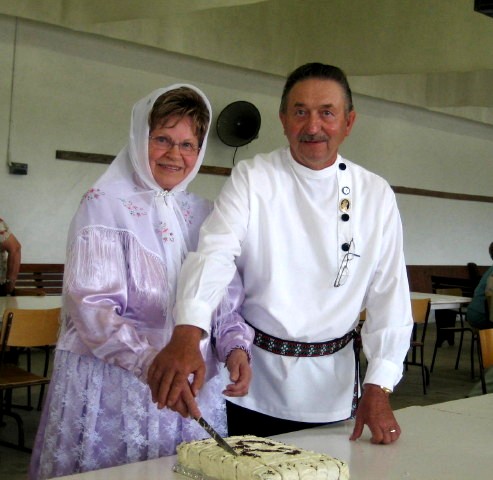 Mary and Alex Sherstabitoff cutting the cake commemorating the 25th Year Heritage Village in Verigin, Saskatchewan July 16, 2006. Photo by Mae Popoff. |
||
|
2006 May 31 — About Former Residents: Growing up on a farm has been invaluable experience for Regina lawyer.(PDF) — A big photo and interview with Jonathan Kalmakoff, appears in The Canora Courier, Canora Sask. Page 8. "Growing up on a farm near
Canora has helped Jon Kalmakoff
understand environmental law, which is part of
his job at SaskPower. He
also participated in drama and debating clubs at school,
which has helped to develop his public speaking
abilities for giving presentations at work."
For 10 years Jon has been researching Doukhobor family
histories and hosting the Doukhobor Genealogy
Website. |
 |
||
|
2006 May 24 — Nik Semenoff: Honorary Doctor of Letters Dr. Nik Semenoff received an Honorary Doctor of Letters from the University of Saskatchewan on Wednesday, May 24, 2006 at 9 am, and gave the Convocation Address. Nik Semenoff was born and educated in Saskatchewan, and is an outstanding researcher, artist, teacher, and inventor. He has taught at the U of S and has been artist-in-residence since 1992. His cutting-edge research into safer printmaking processes has placed the University in the forefront of non-toxic printmaking research and education. As an artist, his work has been commissioned and exhibited internationally, and has been included in major collections. The inventor of the "waterless lithographic process," high-resolution screen-printing and specialty inks, he has made printmaking both safer and less expensive. Professor Semenoff has published his research findings in several refereed journals, and has been invited to do workshops around the world. He is also known and respected for his contributions to the local and provincial arts communities. A founding member of the Saskatchewan Society of Artists and Gallery 9 in Saskatoon, Semenoff has served on the board of the Mendel Art Gallery and was associate director of the Fine Art Committee of the Saskatoon Industrial Exhibition for a number of years. The book, Waterless Lithography: An Artist's Guide to Making Professional-Quality Prints Using Nik Semenoff's Method, by Jacob Semko (Nov 2005) is a best seller among printers.
|
 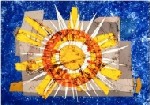 More of Nik's art:
|
||
|
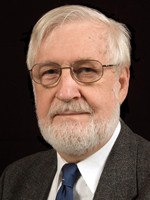
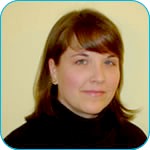
2006 May — Doukhobor / Peace Thesis by Stacey Makortoff, Vancouver Why the Path to Peace is Often Paved in Conflict: A Historical Examination of the Doukhobors of British Columbia. (PFF, 668K) Master of Arts Thesis by Stacey Makortoff, Canada. Peace and Conflict Studies, European University Center for Peace Studies, Stadtschlaining / Burg, Austria. 121 pages. Abstract: "... This paper answers the question of why the quest for peace is often full of conflicts through an examination of the history of the Doukhobors through the framework of worldview developed by the International Education for Peace Institute. This will thus provide an example of why this group (as many others in history) could not bring their peaceful ideals into practice. It will conclude with a discussion of how the Education for Peace Program (implemented for the past six years in Bosnia and Herzegovina) could facilitate the development of a peace- based worldview thus, infusing new life into this historically rich and vibrant community." Since 2004, Stacey has been the Academic Program Coordinator for EFP-International (International Education for Peace Institute), Vancouver, B.C. Before that she taught school in BC and Thailand. She presented her thesis at 2 conferences this year:
|
 |
||
|
1999 June 8 — "Vechnaia Pamyat" Art Exhibit, Grand Forks, B.C. Jan Kabatoff, who works in Canmore, Alberta, curated the exhibition "Vechnaia Pamyat: Honouring Our Doukhobor Heritage" shown at the Grand Forks Art Gallery from June 8 to July 17, 1999. The title means "Eternal Memory" in Russian. The work of 19 contemporary artists of Doukhobor heritage — Sonja Billard, Leah Bojey, Brad Chernoff, Tamara Ewashen, Polly Faminoff, Donna Guillemin, Jan Kabatoff, Barry Koochin, George Koochin, Florence Lymburner, Jeina Morosoff, Wendy Morosoff-Smith, Rebecca Perehudoff, Peter Potapoff, Elaine Rathie, Angie Reabbin, Bill Seminoff, Mabel Verigin and Volga Wright — were shown to to honour and celebrate the 100th anniversary of the arrival of Doukhbors in Canada. The exhibit "... examines contributing factors in the assimilation of an ethnic culture into mainstream society, the loss of one’s cultural identity, and the importance of acknowledging one’s heritage in an exhibition celebrating the centennial of the Doukhobor entry into Canada in 1899. All the participating artists share a common heritage, although many have been away from a Doukhobor community for many years [Gallery Schedule]." Also see: Doukhobor Artist Jan Kabatoff Prepares Exhibit on Glaciers [for September 2009] |
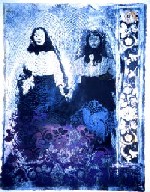 Jan Kabatoff's "I Remember, I Forget..."; dyed, stitched linen mixed media, 1996. |
||
|
1989 December 11 — Jason Konken studying at the Pushkin Institute, Moscow University Third year UVic Slavonics student Jason Konken is studying this year at the Pushkin Institute of Moscow University through the sponsorship of Society Rodina in Russia. Konken, of Grand Forks, British Columbia, applied last spring to the Society and received word of his acceptance in late June. He is in residence in the international dormitory at the Pushkin Institute and receives a monthly stipend from the Society during the 10 months that he is in Moscow studying the Russian language. “My major is Slavonics and I really feel if you’re studying a language immersion is the only way to go. I’m interested in all aspects of Soviet society," Konken said before his departure. When he returns to UVic next year Konken plans to finish his degree here, with a major in Slavonics, and, possibly, history. (Ringers, The Ring : Campus Report, University of Victoria, Canada, Vol.15, No. 22, December 11, 1989, page 4.) In 2002 Konken was the general director of the LD cigarette factory 'Liggett‑Ducat Ukrainein', a subsidiary of the Gallaher Group. (Foreign investment igniting tobcco market, Kyiv Post May 23, 2002; and, Výroba piva a cigariet ťahá nadnárodné spoločnosti na Ukrajinu, Trend.SK, June 28, 2002) In Summer 2007, (photo caption) 'At a Mexican restaurant in Moscow – a birthday party put on by Jason Konken (at right) for his wife Sveta (second from right). Formerly of Grand Forks, BC, Jason has been living and working in Russia and the Ukraine for many years.' (Photo caption) 'Jason says a few words for the occasion. Jason’s father, Jack Konken of Grand Forks, BC, was also one of Ken’s colleagues in the work group of 1990. (Popoff D.E. (Jim). Ken’s amazing Turkish adventure!, Iskra, 1 February 2003, page 23) In 2014 Konken is listed as a Member of 'Gallery 2', (Sketches : The Newsletter of gallery 2 Grand Forks & District Arts & Heritage, Vol. 54, No. 1, January, February, March, 2015, page 6.) |
 |
||
|
1943 June 8 — Conchie Who Tore Up Call-up Order Jailed Calgary, June 8 (CP) — Nick N. Nevokshonoff, a conscientios[sic] objector from a Doukhobor colony at Brilliant, B.C. who said he tore up his mobilization board notices to report for medical examination, was sentenced to 12 months' imprisonment in city police court yesterday morning. On completion of the term he will be escorted by the R.C.M.P. to the Infantry Recruiting centre at Calgary to undergo medical examination. — Found by
Johnathan Kalmakoff in the Winnipeg Free Press, June 8, 1943.
"COnchie" was a common term for "draft dodger" at that time. |
|||
|
More "Hodge Podge" to come. Keep looking. |
|||